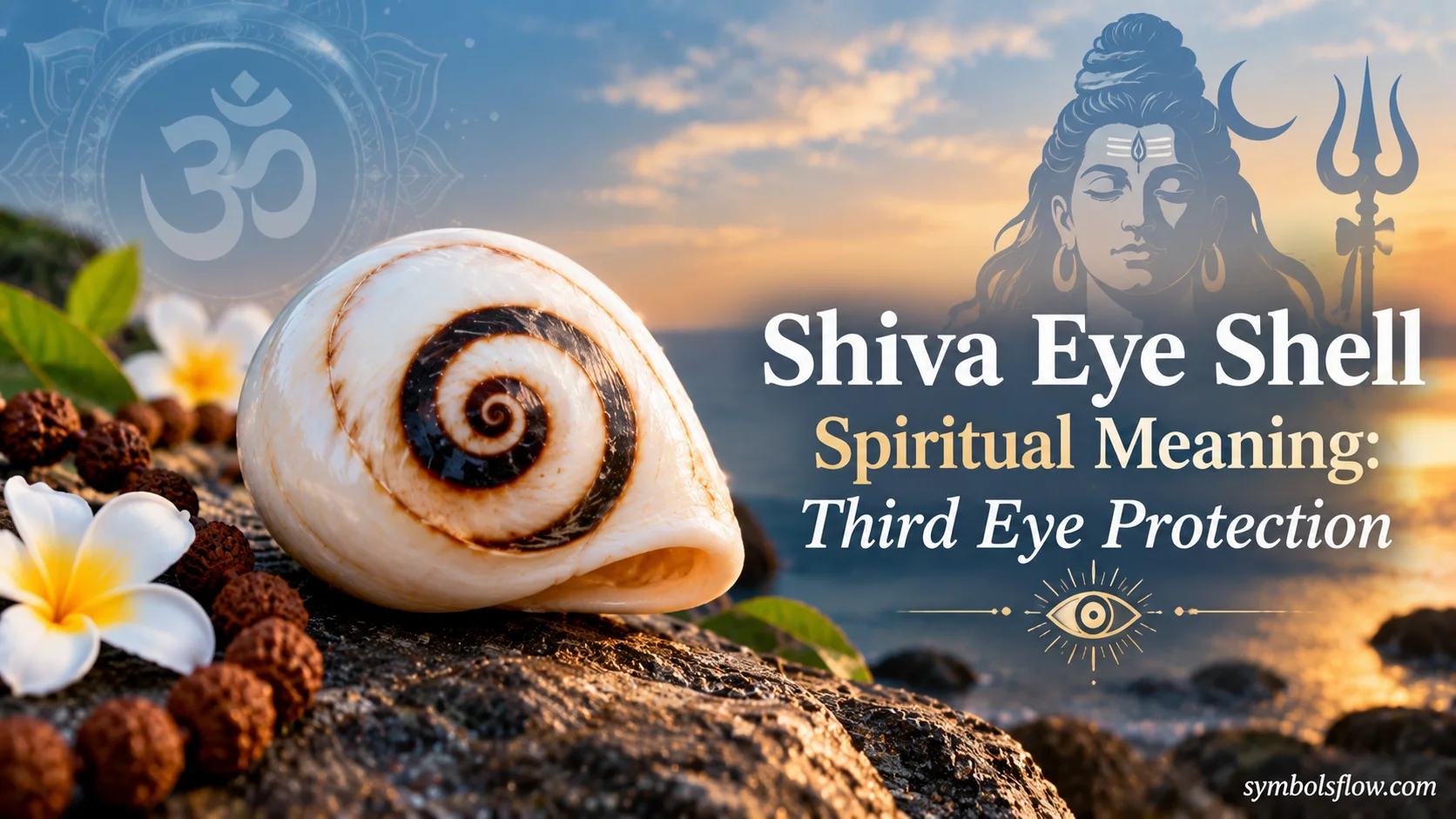
The Shiva Eye Shell Spiritual Meaning: Third Eye Protection connects a small ocean shell with wisdom, protection, transformation, and inner vision through its striking spiral and eye-like appearance.
Known as the Shiva Eyes gemstone, Shiva Netri, or Cat’s Eye in some spiritual contexts, this sacred shell is linked with Lord Shiva and Shiva’s third eye. In Hindu iconography and Hindu spirituality, the third eye represents profound knowledge, inner vision, and the ability to see beyond ordinary appearances. Its destructive aspect symbolizes the removal of illusions and old patterns. The shell itself is the protective operculum, or door, of a marine snail. Its spiritual meaning comes from ancient beliefs, spiritual interpretations, cultural interpretations, and religious imagery.
In Vedic astrology, Vedic beliefs, and other spiritual beliefs, the Shiva Eye shell is viewed by some people as a powerful shield against unseen energies, stress, jealousy, psychic attacks, negative vibrations, and negative energy. Its mystical stone appearance and gemstone symbolism connect it with protective qualities and mystical powers. Its sacred symbolism represents divine protection, spiritual protection, energy protection, psychic protection, spiritual defense, and protection from negativity. Some people see it as a spiritual shield, divine shield, or energetic shield that represents an aura and the desire to ward off evil, resist evil forces, and seek protection against evil. These ideas are symbolic, not scientifically proven. Using the shell as spiritual jewelry can serve as a reminder to pause, reflect, and make thoughtful choices. It may encourage spiritual awareness, higher awareness, spiritual insight, illusion removal, spiritual clarity, true protection, aura protection, protective energies, sacred protection, and wisdom and protection.
“Let’s dive in!
Quick Answer
Shiva Eye Shell Spiritual Meaning: Third Eye Protection is commonly associated with inner wisdom, spiritual awareness, protection, and transformation. In the USA, it’s often treated as a symbolic talisman, while its connection to Shiva comes from the resemblance between its spiral pattern and Shiva’s third eye.
TL;DR
- The Shiva Eye is the protective operculum of certain marine snails.
- Its spiral naturally resembles an eye and suggests inner awareness.
- Shiva’s third eye is associated with wisdom, knowledge, and transformation.
- Modern American spirituality often connects the shell with protection.
- Its meaning varies between traditional Hindu symbolism and newer spiritual practices.
- Today, it appears in jewelry, meditation spaces, decor, and personal symbolism.
What Is a Shiva Eye Shell?
The first step is understanding what this object actually is. Despite being sold in some places alongside crystals and gemstones, a Shiva Eye is not technically a crystal or mineral.
The Natural Form
A Shiva Eye is an operculum, a hard structure that acts like a protective door for certain marine snails. When the animal retreats into its shell, the operculum helps close the opening and protect the soft body inside.
The object is usually small, rounded, and slightly curved. One side often displays a cream, brown, or greenish spiral that can look remarkably like an eye.
Why It Looks Like an Eye
The visual effect is central to its modern symbolism. The spiral creates an impression of an iris or pupil, especially when viewed from a distance.
Because of this appearance, people have connected the shell with watchfulness, awareness, and protection. However, these are symbolic interpretations rather than scientifically demonstrated properties.
What Does the Shiva Eye Shell Symbolize?
For many modern spiritual practitioners, the shell works as a compact symbol of seeing beyond appearances. Its eye-like design naturally supports ideas about awareness and observation.
Inner Vision
Shiva’s third eye is often interpreted as a symbol of deeper knowledge. Museum collections describe it as representing wisdom, knowledge, inner vision, or the ability to see beyond ordinary appearances.
The shell therefore becomes a visual reminder to pause before accepting things at face value.
Common symbolic associations include:
- Inner wisdom and deeper awareness
- Spiritual protection and watchfulness
- Transformation through insight
- Cycles, renewal, and personal growth
- Intuition and reflective thinking
These meanings are especially common in contemporary spiritual and metaphysical settings.
Shiva’s Third Eye and Its Deeper Meaning
The strongest cultural connection behind the name comes from Hindu representations of Shiva. His third eye appears vertically in the center of his forehead and is one of his most recognizable features.
Wisdom and Inner Vision
In several Hindu interpretations, the third eye represents a form of vision that goes beyond ordinary sensory perception. It can therefore symbolize knowledge, awareness, and freedom from illusion.
At the same time, Shiva’s third eye is not simply a peaceful symbol. It can also release destructive fire. This destruction can represent the removal of desire, ignorance, or conditions that must change.
Protection Through Awareness
This creates an important distinction. Protection does not always mean creating a magical shield around a person.
Symbolically, protection can also mean seeing clearly. A person who notices harmful patterns, misleading appearances, or unhealthy attachments may respond with greater awareness.
That interpretation helps explain why the Shiva Eye shell can represent both protection and transformation.
Historical Roots of Shiva’s Third Eye
The third eye is an established part of Shiva’s religious iconography, long predating the modern crystal and spiritual-product markets. Archaeological and museum collections show Shiva represented with three eyes across different periods and regions of South and Southeast Asia.
Ancient and Medieval Iconography
A Kushan-era panel from around the third century CE already depicts Shiva with a prominent third eye. Later Indian sculptures continued this feature, including works from the sixth, seventh, and eighth centuries.
The symbolism also traveled across Asia. Cambodian representations of Shiva commonly include the vertical third eye, showing how the imagery developed within broader South and Southeast Asian religious art.
Stories Behind the Eye
Hindu traditions contain different stories explaining Shiva’s third eye. One well-known story describes Parvati covering Shiva’s two ordinary eyes while he was meditating.
The world was plunged into darkness, and a third eye appeared on Shiva’s forehead. In the story, its fire demonstrates both tremendous power and the danger of uncontrolled force.
The shell itself should not be presented as an ancient Hindu artifact simply because modern sellers call it “Shiva Eye.” The name reflects a later symbolic association based strongly on appearance.
Shiva Eye Shell Spiritual Meaning in the USA
In the United States, Shiva Eye shells are commonly encountered outside formal Hindu religious settings. They appear in jewelry, alternative spirituality, meditation spaces, coastal crafts, and personal collections.
A Symbol of Personal Awareness
American spiritual culture often blends symbols from many traditions. In that setting, the shell may represent an individual’s desire to become more observant, intuitive, centered, or spiritually aware.
The symbol can therefore function as a personal reminder rather than a formal religious object.
| Context | Meaning in the USA | Common Association | Important Note |
| Jewelry | Protection and awareness | Personal talisman | Usually a modern spiritual interpretation |
| Meditation | Inner vision | Reflection and focus | Meaning depends on the practitioner’s beliefs |
| Home decor | Calm and nature | Ocean, cycles, beauty | Often primarily decorative |
| Gifts | Guidance and protection | Good intentions | Symbolism can vary by recipient |
| Tattoos | Transformation | Third-eye imagery | May combine Hindu and modern motifs |
For American readers, context matters. A shell worn as fashion does not automatically indicate a specific religious identity.
Cross-Cultural and Spiritual Meanings
The Shiva Eye shell has gathered meanings beyond its association with Shiva. Some modern sources connect it with good fortune, travelers, fishermen, ocean energy, and protection from harmful influences.
Ocean Symbolism
Because the shell comes from the sea, modern interpretations often connect it with water, movement, emotional flow, and natural cycles.
Its spiral can also suggest returning to a center. That makes it appealing to people who see personal growth as a process rather than a straight path.
Respecting Religious Context
However, the Shiva connection deserves care. Shiva is not simply a generic “third-eye symbol” in Hindu traditions.
For many Hindus, Shiva is a major deity with complex religious, philosophical, and devotional meanings. His third eye forms part of a much larger body of religious stories and iconography.
Using the shell as personal symbolism can be meaningful, but it’s helpful not to claim that every modern interpretation represents traditional Hindu belief.
The Spiral as a Symbol of Transformation
The shell’s spiral gives it another layer of meaning. Spirals appear widely in human art because they can suggest movement, growth, return, and unfolding.
Cycles and Renewal
A spiral doesn’t simply move outward. It repeatedly curves around a center.
For this reason, modern spiritual interpretations often associate the Shiva Eye with cycles of experience. Change may involve revisiting old lessons from a new perspective.
The symbolism can suggest:
- Growth that happens gradually
- Returning to important personal lessons
- Transformation through repeated experiences
- Movement from confusion toward clarity
- Balance between change and stability
These ideas are symbolic rather than universal rules. Different people can reasonably interpret the same spiral in different ways.
Read More: Dog Bite on Right Hand: Spiritual Meaning
Emotional and Psychological Associations
Symbols often gain power because people attach memories and emotions to them. The Shiva Eye shell can function as a physical reminder of qualities someone wants to cultivate.
Calm Observation
An eye naturally suggests paying attention. The spiral adds a sense of inward movement.
Together, these features can create an association with quiet observation rather than immediate reaction. Someone might keep the shell nearby as a reminder to pause, reflect, and look more carefully at a situation.
Personal Identity
In modern American culture, symbolic jewelry often communicates personal values without requiring a long explanation.
A Shiva Eye pendant might represent someone’s interest in spirituality, ocean imagery, personal transformation, or protective symbolism. However, its meaning should ultimately be understood through the wearer’s own context.
Shiva Eye Shell in Meditation and Personal Rituals
Modern practitioners sometimes place Shiva Eye shells near meditation areas or hold them during reflective practices. These uses belong mainly to contemporary spiritual practice rather than a single universal Hindu ritual.
A Symbolic Practice
Someone might simply hold the shell and focus on its spiral. The purpose can be reflective rather than supernatural.
For example, the spiral can serve as a visual cue for slowing down and returning attention to the present moment.
Personal Reflection
A simple reflective practice might involve asking:
- What am I not seeing clearly?
- What lesson keeps returning in my life?
- Where do I need stronger boundaries?
- What change am I resisting?
- What deserves deeper attention?
The value comes from the reflection itself, not from claiming that the shell has scientifically proven powers.
Shiva Eye Shell Jewelry, Tattoos, and Decor
The distinctive pattern makes Shiva Eye shells visually attractive. As a result, their symbolism has become increasingly visible in modern accessories and decorative objects.
Jewelry
Pendants, earrings, bracelets, and small polished shells are common ways to display the symbol. The eye pattern makes the object immediately recognizable.
In American spiritual fashion, it may be paired with other natural materials, beads, shells, or symbolic charms.
Tattoos and Artwork
Some people adapt the spiral into tattoo designs featuring eyes, mandalas, lotus flowers, or Shiva-inspired imagery.
However, combining sacred Hindu imagery with unrelated symbols can change the original context. Anyone choosing such artwork may benefit from understanding the traditions behind the imagery.
Protection, the Evil Eye, and Common Confusion
One reason the Shiva Eye shell is often described as protective is its resemblance to an eye. Eye symbols have protective meanings in many cultures, including traditions involving the “evil eye.”
Similar Does Not Mean Identical
The Shiva Eye should not automatically be treated as the same symbol as the Nazar or other evil-eye traditions.
These traditions have different histories and cultural contexts. Their visual similarities can encourage modern mixing, but they should not be presented as one ancient universal belief.
What “Protection” Can Mean
In contemporary spiritual language, protection may refer to several different ideas:
- A reminder to maintain personal boundaries
- A symbol of vigilance and awareness
- A comforting object during uncertain periods
- A representation of spiritual strength
- A reminder to recognize harmful patterns
These interpretations are personal or spiritual beliefs, not established scientific effects.
Misunderstandings and Modern Misuse
The popularity of the Shiva Eye has also produced several misconceptions. One common mistake is calling it a gemstone or crystal.
Scientifically, it is an organic shell structure rather than a conventional mineral crystal.
Another Common Misunderstanding
Some modern descriptions suggest that the shell has been universally revered for thousands of years as Shiva’s third eye. Evidence for the shell itself having that continuous historical status is much weaker than the well-documented history of Shiva’s third-eye iconography.
That distinction matters because Shiva’s third eye has a substantial religious and artistic history, while the shell’s modern name and metaphysical interpretations are much harder to trace as a continuous ancient tradition.
How the Meaning Has Changed Over Time
The story of the Shiva Eye shows how symbols can evolve. First, there is the physical object: a marine snail’s protective operculum.
Later, people noticed its eye-like spiral and connected that visual feature with Shiva’s third eye. Modern spiritual markets then expanded the symbolism to include intuition, energetic protection, meditation, transformation, and personal growth.
From Natural Object to Spiritual Symbol
This shift doesn’t make the modern meaning meaningless. It simply means different layers should be kept separate.
The shell has a biological identity. Shiva’s third eye has a religious and artistic identity. Contemporary spirituality has added another interpretive layer.
Understanding all three makes the symbol more interesting and avoids presenting modern beliefs as ancient facts.
What the Shiva Eye Shell Can Represent Today
For a modern American reader, the shell can be understood as a symbol with several overlapping meanings. Its strongest visual message comes from the combination of an eye and a spiral.
A Symbolic Summary
Today, people may use the Shiva Eye shell to represent:
- Seeing beyond surface appearances
- Developing greater self-awareness
- Protecting personal boundaries
- Accepting cycles of change
- Remembering spiritual or personal values
- Staying curious during uncertain times
The meaning depends heavily on context. A Hindu devotee, a jewelry collector, and a modern spiritual practitioner may each understand the same object differently.
FAQs
Is the Shiva Eye shell really connected to Lord Shiva?
The name comes from its visual resemblance to Shiva’s third eye. Shiva’s third eye is well documented in Hindu art and symbolism, while the shell’s specific spiritual interpretation is largely a later association.
What does the Shiva Eye shell symbolize spiritually?
Modern spiritual interpretations commonly connect it with inner vision, wisdom, protection, intuition, and transformation.
Is Shiva Eye a crystal?
No. A Shiva Eye is an operculum, or protective structure, from a marine snail. It may be sold alongside crystals, but it isn’t technically a crystal or gemstone.
Does the Shiva Eye shell protect against negative energy?
Some spiritual practitioners believe it provides symbolic or energetic protection. There is no scientific evidence establishing that the shell itself blocks negative energy.
What does the spiral on a Shiva Eye shell mean?
The spiral is a natural feature of the operculum. Symbolically, modern interpretations often connect it with cycles, growth, transformation, and returning to one’s center.
Conclusion:
The Shiva Eye Shell Spiritual Meaning: Third Eye Protection brings together a natural ocean object, the powerful symbolism of Shiva’s third eye, and modern ideas about awareness and protection. Its spiral can suggest cycles, while its eye-like appearance encourages associations with deeper seeing and wisdom.

1 thought on “Shiva Eye Shell Spiritual Meaning: Third Eye Protection”