
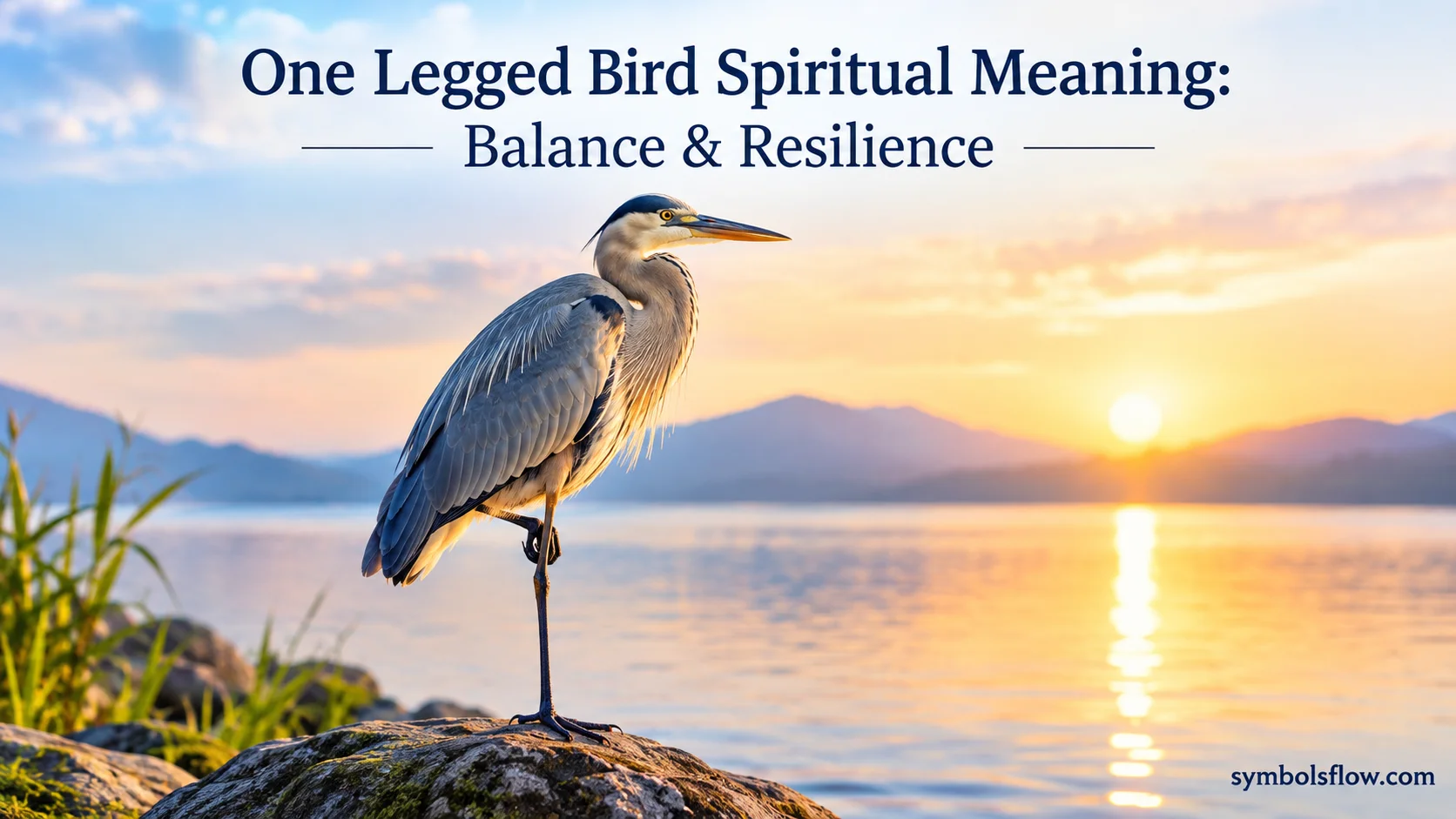
One Legged Bird Spiritual Meaning: Balance & Resilience reflects balance, resilience, patience, and strength during uncertain moments in life.
A bird standing near a house, window, or perched quietly can become a personal sign. Birds, one-legged bird encounters, signs from birds, owl sightings, an owl fly moment, or birds seen through a car window with beautiful wings may create a feeling of connection. Many people view birds as bridges to the spirit world, messengers from the heavens, or symbols of flight and spiritual awareness. A real birds resting on one leg differs from a mythical bird with only one leg. Birds may naturally rests by placing a foot beneath their feathers. This resting behavior can conserve heat, reduce strain, and provide a comfortable resting position.
The image can represent staying steady, temporary imbalance, finding strength, uncertainty, and perfect conditions without making the moment a warning about fighting or depression. The same idea appears in recognizable flowers such as the tiger lily, known for bright orange petals, dark spots, bold appearance, confidence, passion, independence, personal strength, courage, individuality, determination, and a fearless attitude. In modern American culture, its presence in gardens, tattoos, artwork, and gifts highlights its stronger visual presence, upright shape, and dramatic colors. Delicate flowers, softness, and innocence create different associations. Natural features, historical uses, cultures, and time shape these meanings and support the idea of adapting to change through a personal symbol.
“Let’s dive in!
Quick Answer
The One Legged Bird Spiritual Meaning in the USA commonly points to balance, resilience, patience, and adapting when life feels uncertain. More broadly, a one-legged bird can symbolize stillness, independence, transformation, or an unusual path, depending on its cultural and personal context.
TL;DR
- A one-legged bird can symbolize balance during difficult times.
- Its posture often suggests patience, rest, and quiet strength.
- Real birds commonly stand on one leg for practical reasons.
- Chinese mythology includes the unusual one-legged Bifang bird.
- Modern interpretations often connect the image with resilience.
- Personal context matters more than any single fixed meaning.
What Does a One Legged Bird Symbolize?
A one-legged bird is usually interpreted through its posture rather than one universal tradition. The raised foot creates a visual contrast between stability and vulnerability.
For an American reader, that contrast can feel especially meaningful. It resembles the idea of remaining grounded while one part of life remains uncertain.
Balance and Stability
The strongest modern interpretation is balance.
The bird appears vulnerable because only one foot touches the ground. Yet it remains upright, calm, and capable.
This creates a simple symbolic message: stability doesn’t always require perfect circumstances.
Common Symbolic Associations
People may connect the image with:
- Balance between action and rest
- Strength during temporary difficulty
- Patience before making a decision
- Adaptation to changing circumstances
- Independence and unusual personal choices
- Quiet confidence without dramatic action
These meanings are modern interpretations, not fixed rules. The same image may feel peaceful to one person and unsettling to another.
Why Do Birds Stand on One Leg?
Before assigning spiritual meaning, it helps to understand the natural behavior. Many birds stand on one leg simply because it is useful.
Birds can tuck one foot into their feathers while resting. This can reduce exposed skin and help conserve body heat, especially in colder conditions.
Natural Reasons for the Posture
Several practical explanations are associated with this behavior:
- Conserving body heat in cool weather
- Giving one leg a period of rest
- Maintaining a comfortable resting position
- Reducing exposed skin around the legs and feet
- Remaining still while resting or sleeping
- Using natural balance mechanisms efficiently
Therefore, seeing a bird on one leg doesn’t automatically indicate a supernatural event.
The Symbolic Lesson
Still, ordinary behavior can inspire symbolic reflection.
The bird doesn’t appear to fight its posture. Instead, it adjusts naturally and remains steady.
That can become a useful metaphor for human life: sometimes adaptation works better than resistance.
Ancient Roots of One Legged Bird Symbolism
The exact idea of a generic “one-legged bird” does not have one continuous symbolic tradition. Instead, unusual birds appear in several older mythologies and artistic traditions.
One of the clearest examples comes from ancient Chinese literature. The Bifang, or Bi Fang, is described as a one-legged mythical bird associated with unusual fire.
The Bifang in Chinese Mythology
Bifang is not simply a normal bird missing a leg. It is a supernatural creature with its own identity.
Descriptions connect it with unusual colors, a crane-like appearance, and strange fires. However, modern retellings sometimes add details that aren’t clearly supported by the earliest texts.
This distinction matters because mythology changes as stories are retold.
The one-legged form therefore represents something unusual and outside ordinary expectations. It can be understood as a reminder that nature and the supernatural were not always sharply separated in ancient storytelling.
A Different Irish Example
Irish legendary literature also contains a striking one-legged bird image. In The Adventures of Art son of Conn, one bird has one leg while another has twelve. Their contest becomes part of a larger symbolic struggle.
This does not establish a universal Celtic meaning for one-legged birds. Instead, it shows that unusual bird forms could carry dramatic symbolic weight in older storytelling.
One Legged Bird Spiritual Meaning in the USA
In modern America, the image is usually approached through personal symbolism rather than one established national tradition.
American culture often values independence, persistence, adaptation, and self-direction. Because of that, the one-legged bird can easily become a metaphor for standing strong despite unusual circumstances.
What It Can Represent
For a modern American audience, the image may suggest:
- Staying grounded during personal uncertainty
- Continuing forward after an unexpected setback
- Choosing a different path from the crowd
- Taking time to rest without feeling guilty
- Trusting your ability to adapt
The meaning becomes especially powerful when someone encounters the bird during a major life transition.
Why the Image Feels Powerful
A bird normally suggests freedom because it can fly.
One leg introduces another idea: grounding.
Together, the two images create an interesting contrast. The bird represents freedom while its single foot represents stability.
That combination can symbolize freedom with responsibility rather than freedom without limits.
What Does a One Legged Bird Mean Spiritually?
Spiritually, a one-legged bird can be viewed as a reminder to stay centered while life changes around you.
It can also represent a pause. The bird has not necessarily stopped moving forever; it may simply be resting before continuing.
Balance Between Movement and Stillness
Bird symbolism often involves movement, flight, freedom, and transition. A raised foot changes that picture.
Instead of flying, the bird is temporarily still.
That can suggest that growth doesn’t always require immediate action. Sometimes reflection and rest are part of progress.
A Symbol of Inner Strength
The image may also represent strength that isn’t obvious at first glance.
The bird looks physically vulnerable. Yet it can maintain its position with remarkable ease.
Symbolically, this can represent people who remain composed despite carrying hidden challenges.
One Legged Bird as a Sign of Resilience
Resilience is one of the strongest modern interpretations of this image.
A bird balancing on one leg appears to have fewer resources than expected. Yet it continues functioning normally.
That creates a natural metaphor for adapting when circumstances aren’t ideal.
Resilience Without Perfection
The symbol doesn’t necessarily say that hardship makes someone stronger.
Instead, it can suggest that people can learn to work with changing circumstances.
That distinction makes the symbol more realistic and compassionate.
Lessons the Image May Suggest
- You don’t need perfect conditions to remain steady.
- Rest can support resilience rather than weaken it.
- Adaptation can be wiser than constant resistance.
- Unusual circumstances don’t automatically mean failure.
- Small adjustments can create meaningful stability.
These are reflective interpretations rather than predictions about what will happen.
Emotional and Psychological Meaning
The image can also carry emotional associations.
A person who feels overwhelmed may see the one-legged bird as a picture of composure. Someone experiencing change may instead notice its adaptability.
Feelings Associated With the Symbol
Depending on context, the image can evoke:
- Calmness
- Patience
- Vulnerability
- Independence
- Hope
- Determination
- Curiosity
- Quiet confidence
However, symbolism is personal. A person recovering from loss may interpret the missing leg differently from someone simply watching a resting heron.
The Power of Contrast
Psychologically, the image works because it contains tension.
The bird looks unstable, yet it is stable.
It appears restricted, yet it remains free.
It is still, yet it can fly at any moment.
These contrasts make the image useful for personal reflection.
One Legged Bird in Different Cultural Traditions
There isn’t one worldwide meaning for a one-legged bird. Instead, different traditions attach different ideas to unusual birds, cranes, posture, and supernatural creatures.
Chinese Traditions
Bifang provides one of the clearest examples of a mythical one-legged bird. Its ancient descriptions connect the creature with unusual fire and supernatural imagery.
Irish Traditions
Older Irish storytelling includes unusual one-legged bird imagery within larger tales about conflict, destiny, and legitimacy. However, it should not be reduced to a simple modern definition such as “one-legged bird equals good luck.”
Chinese Artistic Traditions
Birds standing on one leg also appear in Chinese art and decorative objects. Modern interpretations have sometimes associated the pose with independence of spirit, although individual artworks require their own context.
A Respectful Approach
It is better to say that these traditions contain related imagery rather than claiming they all share one meaning.
That approach avoids turning diverse cultures into a single symbolic system.
One Legged Bird Meaning in Dreams
A one-legged bird appearing in a dream can have a highly personal meaning.
Dream symbolism isn’t scientifically fixed, so the most useful interpretation usually comes from the dreamer’s feelings and circumstances.
Common Personal Interpretations
A dream may bring the image to mind when someone is:
- Trying to maintain balance during uncertainty
- Adjusting to an unexpected life change
- Feeling different from people around them
- Needing more rest before taking action
- Learning to trust their own abilities
The bird’s behavior also matters.
A calm bird may suggest acceptance. A frightened bird may reflect anxiety or vulnerability.
Read More: One Legged Crow Spiritual Meaning: Resilience
One Legged Bird Meaning in Nature Encounters
Seeing a bird standing on one leg can feel meaningful, especially when the encounter happens during an emotional period.
However, the natural explanation should come first. Birds commonly use this posture for resting, warmth, and comfort.
A Simple Way to Reflect
Instead of asking, “What does this bird predict?” consider asking:
“What does this image make me think about right now?”
That question keeps the experience personal without treating wildlife behavior as a guaranteed supernatural message.
Context Can Change the Meaning
| Context | Meaning in the USA | Common Association | Helpful Perspective |
| Bird resting calmly | Balance and peace | Patience | Notice your need for rest |
| Bird near water | Adaptation | Emotional flexibility | Consider changing circumstances |
| Bird during hardship | Resilience | Endurance | Focus on practical next steps |
| Mythical one-legged bird | Mystery | Transformation | Explore its specific tradition |
| Bird in artwork or tattoo | Personal identity | Independence | Ask what the design means to you |
One Legged Bird Tattoos and Modern Symbolism
Bird tattoos already carry strong associations with freedom, movement, and personal transformation.
Adding a one-legged posture creates a more unusual message.
Popular Symbolic Ideas
A person might choose the design to represent:
- Remaining balanced through adversity
- Recovering from a major life change
- Embracing an unconventional identity
- Valuing patience and quiet strength
- Remembering a difficult period with hope
The design can also be purely artistic. Not every tattoo needs a spiritual meaning.
Design Details Matter
A flamingo, heron, crane, or fictional bird can create very different impressions.
For example, a flamingo may feel playful and colorful. A dark crane silhouette may feel more reflective and minimalist.
The surrounding elements can change the message even more.
One Legged Bird in Art, Decor, and Social Media
Today, unusual bird imagery works well in visual culture because it is instantly recognizable.
A single raised foot creates an elegant shape. It can also suggest movement, pause, or balance without requiring words.
Modern Uses
You may encounter the image in:
- Nature photography
- Wall art and illustrations
- Tattoo designs
- Meditation-themed artwork
- Social media photography
- Personal journals and vision boards
- Seasonal and nature-inspired decor
On social media, people may also use a one-legged bird as a humorous nature moment rather than a spiritual symbol.
That distinction is important. The same image can be meaningful, funny, artistic, or simply natural.
Misunderstandings and Controversies
The biggest misunderstanding is assuming every one-legged bird has a supernatural meaning.
In reality, many birds naturally stand on one leg. This behavior is common across several groups, including waterbirds and some smaller perching birds.
Natural Behavior vs. Injury
A bird lifting one leg does not automatically mean the leg is injured.
A healthy resting bird may switch legs and behave normally. However, persistent avoidance of one foot, visible injury, or unusual distress can have a different explanation.
For wild birds, observation from a safe distance is usually best.
Avoiding Cultural Misuse
Mythological one-legged birds should also be treated according to their specific traditions.
For example, Bifang is a particular figure in Chinese mythology. It shouldn’t automatically be treated as a generic “spiritual animal” detached from its historical setting.
Respectful symbolism keeps the original cultural context visible.
How the Meaning Has Changed Over Time
The meaning of unusual bird imagery has never stayed completely fixed.
Ancient stories often treated strange birds as supernatural beings, omens, or extraordinary creatures. Modern readers are more likely to interpret the same visual form psychologically.
From Myth to Personal Symbol
The shift can be summarized simply:
Ancient storytelling → cultural imagery → artistic symbolism → personal interpretation
Today, someone may see a one-legged bird and think about resilience without knowing any ancient mythology.
That doesn’t make the modern interpretation wrong. It simply makes it a modern interpretation.
What Remains Consistent
Across these changing contexts, several ideas remain easy to recognize.
The image still creates a strong contrast between vulnerability and stability. That contrast explains much of its lasting symbolic appeal.
Is a One Legged Bird a Good Spiritual Sign?
For many people, it can be viewed positively.
Its strongest modern associations include balance, patience, resilience, adaptability, and quiet confidence. However, there is no universal spiritual rule saying that seeing one is always a good or bad sign.
A More Grounded Interpretation
Rather than treating the bird as a prediction, consider it a prompt for reflection.
Ask yourself what was happening when you noticed it. Your emotional response may reveal more than the bird’s posture itself.
A meaningful symbol doesn’t have to predict the future to be useful.
FAQs:
1. What does a one-legged bird symbolize spiritually?
A one-legged bird can symbolize balance, resilience, patience, and the ability to remain steady during uncertain times.
2. Is seeing a bird on one leg a spiritual sign?
Some people interpret the sight as a personal symbol of staying steady, adapting to change, and finding strength during temporary imbalance.
3. Why do birds stand on one leg?
Many birds tuck one foot beneath their feathers while resting. This can help conserve heat, reduce strain, and provide a comfortable resting position.
4. What does a one-legged bird mean during difficult times?
It may represent resilience and finding strength without needing perfect conditions. The image can serve as a reminder to remain patient and grounded.
5. Does a one-legged bird always have a spiritual meaning?
Not necessarily. A bird standing on one leg is often normal resting behavior. Any spiritual meaning depends on a person’s beliefs and personal experience.
Conclusion:
The One Legged Bird Spiritual Meaning centers on balance, resilience, patience, and adapting to change. A bird resting on one leg can naturally demonstrate how to stay steady while conserving energy. As a personal symbol, it may remind you that temporary imbalance does not mean weakness. Its simple image can encourage patience, inner strength, and confidence while moving through uncertain moments.

1 thought on “One Legged Bird Spiritual Meaning: Balance & Resilience”