
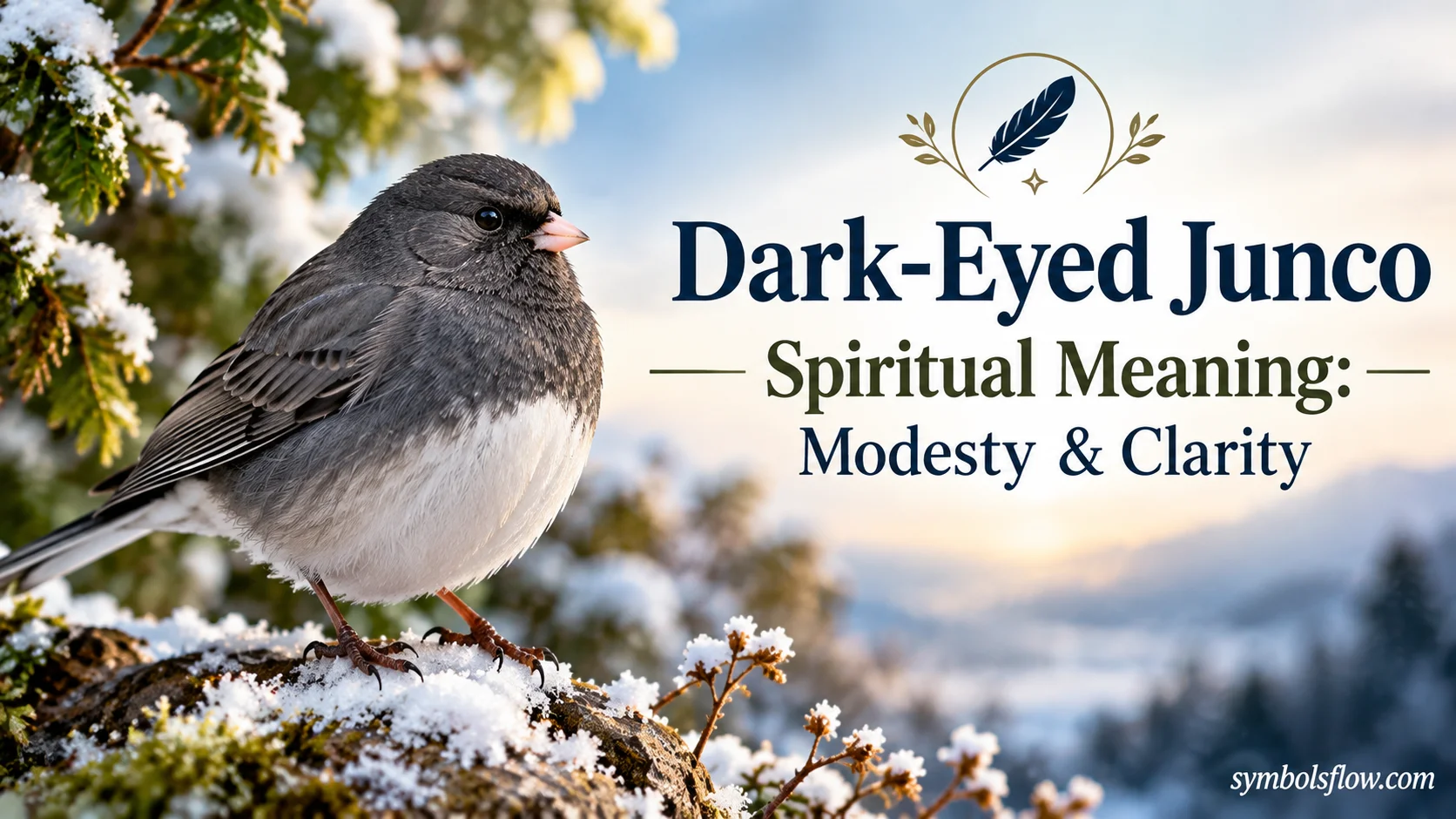
Dark-Eyed Junco Spiritual Meaning: Modesty & Clarity points to quiet wisdom found in ordinary moments of nature and daily life.
The human imagination has long viewed birds in stories, dreams, traditions, and everyday moments as symbols of freedom, hope, change, and spiritual guidance. A bird sighting may feel like a coincidence or a message, giving spiritual meaning to encounters with cardinals, owls, ravens, hummingbirds, and blue jays. The junco adds its own deeper meanings through its quiet appearance, seasonal habits, and gentle presence. This small North American bird appears on the ground, around backyards, parks, and woodland edges. Its gray plumage and bright white outer tail feathers create a striking appearance that remains simple.
Its dual colors suggest symmetry and stability, with upper black and lower white stripes reflecting happiness, sorrow, light, shade, truth, and darkness. The bird can teach us to accept life’s contrasts, learn through each process, and find a sense of home within changing circumstances. For modern readers, these qualities include humility, clear thinking, adaptability, patience, and peaceful change. The importance of the junco for personal growth and spiritual insight rests in self-reflection, helping us remain humble, stay change-adaptable, keep life simple, and recognize what is essential for life’s journey, achieving contentment, and deeper spiritual understanding. In the United States, juncos are familiar during colder months. Some populations migrate seasonally, while others stay in the same region throughout the year. Winter, movement, life cycles, and adjustment can become personal signs for reflection. These modern symbolic interpretations are not fixed religious facts; they offer a way to explore understanding, meaning, and the quiet lessons a bird may symbolize.
“Let’s dive in!
Quick Answer
Dark Eyed Junco Spiritual Meaning: Modesty and Clarity can symbolize quiet confidence, humility, clear awareness, and resilience in the United States. Spiritually, people may also interpret the bird as a reminder to simplify life, accept change, and notice what matters without seeking attention.
TL;DR
• The junco commonly represents modesty, clarity, simplicity, and resilience.
• Its gray and white coloring can suggest balance and calm awareness.
• Winter appearances connect the bird with patience and seasonal change.
• Its ground-feeding habits can symbolize staying practical and grounded.
• Modern spiritual meanings are personal rather than universal religious teachings.
What Does a Dark-Eyed Junco Look Like?
The dark-eyed junco is a small sparrow-like bird with considerable regional variation. Many forms have gray or brown upper feathers, a lighter underside, a pale bill, and noticeable white outer tail feathers.
That understated appearance helps explain why modern symbolic interpretations often focus on modesty rather than display. The bird isn’t usually associated with brilliant colors or dramatic size.
Gray, White, and Dark Features
Gray can be interpreted symbolically as neutrality, balance, and calmness. White may suggest openness or clarity, while darker facial markings can represent inward attention or thoughtful observation.
These are symbolic readings, not scientific meanings attached to feather colors. Still, visual symbolism can influence how people connect an animal with personal values.
The White Tail Flash
One of the junco’s most recognizable features is its white outer tail feathers. They become especially noticeable during flight, creating an interesting contrast with the bird’s otherwise muted appearance.
Symbolically, this contrast can suggest that something meaningful may remain hidden until the right moment. It fits naturally with themes of clarity, discovery, and quiet expression.
What Does the Dark-Eyed Junco Symbolize?
Modern interpretations often connect the junco with qualities that are gentle but steady. Its behavior provides useful inspiration for symbolic readings without requiring a supernatural explanation.
Core Symbolic Meanings
The dark-eyed junco can represent:
• Modesty without losing personal strength
• Clarity after confusion or emotional noise
• Adaptability during changing circumstances
• Patience during quieter seasons of life
• Simplicity instead of unnecessary complexity
• Grounded attention to ordinary experiences
The strongest interpretation depends on the situation in which someone notices the bird. A junco appearing during a stressful period may feel like a reminder to slow down and regain perspective.
What Does the Junco Mean Spiritually?
Spiritual interpretations of the junco are mostly modern and personal. There is no single worldwide religious doctrine that assigns one official spiritual meaning to this species.
A Symbol of Modesty
The junco’s understated appearance makes modesty a natural symbolic theme. It doesn’t need dramatic colors or impressive size to remain noticeable.
For someone thinking about personal growth, the bird may represent confidence that doesn’t require constant recognition. Modesty here means knowing your value without needing to prove it constantly.
A Symbol of Clarity
The contrast between the junco’s darker upper body and lighter underside can inspire ideas about seeing clearly through complexity. Its white tail becoming visible during flight can also encourage a symbolic reading about hidden qualities becoming apparent.
In this sense, clarity doesn’t necessarily mean knowing the future. Instead, it can mean recognizing what deserves your attention now.
Dark-Eyed Junco Spiritual Meaning in the United States
In the United States, the junco is closely connected with everyday encounters with nature. People may see it in backyards, parks, open woodland, and beneath bird feeders, particularly during winter.
Why Americans Notice the Junco
The bird is common enough to become part of ordinary seasonal experience. Its presence can therefore carry a more intimate symbolism than rare or exotic animals.
| Context | Meaning in the USA | Common Association | Symbolic Reading |
| Winter appearance | Endurance | Cold weather | Staying steady |
| Backyard visit | Simplicity | Home and nature | Appreciating ordinary life |
| Seasonal movement | Adaptability | Migration | Accepting change |
| White tail flash | Clarity | Sudden visibility | Seeing something differently |
| Ground feeding | Grounding | Practical survival | Staying connected to reality |
For many Americans, the junco can therefore symbolize strength in ordinary life. It reminds us that resilience doesn’t always look dramatic.
What Is the Historical Origin of Junco Symbolism?
The dark-eyed junco has a documented scientific history, but its modern spiritual symbolism should not be confused with an ancient universal tradition.
Scientific History
Carl Linnaeus formally described the bird in 1758 as Fringilla hyemalis. The description was based on earlier observations of the bird in North America, including work by Mark Catesby.
The modern scientific name is Junco hyemalis. The species name hyemalis relates to winter, fitting the bird’s well-known seasonal presence. The genus name Junco comes through Spanish junco, meaning rush or reed, from Latin iuncus.
The “Snowbird” Connection
The junco has long been associated with winter in American bird language. Historical observers noticed its appearance in places such as Virginia and Carolina during colder months.
That history helps explain why modern symbolism frequently connects the bird with winter, endurance, rest, transition, and renewal.
Read More: Death Head Moth Spiritual Meaning: Transformation
Are There Ancient or Pre-Christian Junco Meanings?
There is no well-established ancient Mediterranean or pre-Christian symbolic tradition specifically centered on the dark-eyed junco. The species is native to North America, so claims that it carried one ancient European spiritual meaning should be treated carefully.
Broader Bird Symbolism
Birds have held symbolic roles in many cultures because they move through the sky, travel long distances, and interact with different landscapes. However, those broad bird meanings shouldn’t automatically be assigned to the junco.
Similarly, Indigenous peoples of North America have diverse traditions involving birds and the natural world. These traditions differ by nation, language, geography, and history.
Why Cultural Precision Matters
It’s tempting to describe one animal as having a single “Native American meaning.” That approach can erase important cultural differences.
There is evidence of Indigenous naming and close seasonal knowledge surrounding the junco. For example, the University of Minnesota notes Dakota and Anishinaabe knowledge and names connected with Minnesota’s plants and animals. However, that does not establish one universal spiritual meaning for the species.
Why Does the Junco Represent Modesty?
Modesty is one of the clearest modern interpretations of the junco’s appearance. The bird is relatively small and usually has muted gray, brown, black, and white coloring.
Quiet Strength
The junco doesn’t need visual extravagance to survive. It searches for food, moves through changing environments, and participates in social groups.
This can inspire a symbolic message: being understated doesn’t mean being weak.
Simplicity as a Value
The junco also fits the idea of finding value in ordinary experiences. Watching a small bird search through leaves may encourage someone to notice details that are easily overlooked.
For modern readers, this can translate into a simple reminder: not everything meaningful needs to be impressive.
Why Does the Junco Represent Clarity?
Clarity is closely related to observation. The junco spends much of its time on or near the ground, moving through leaves and open areas while searching for food.
Grounded Awareness
Unlike a symbolic interpretation focused only on flight and freedom, the junco offers another image. It stays close to the ground and responds to its surroundings.
That can represent practical awareness. Instead of escaping every problem, clarity may involve looking carefully at what is actually happening.
Seeing What Was Already There
The white tail feathers become visible when the bird moves. Symbolically, this can suggest that clarity sometimes comes from changing your position rather than changing reality.
A situation may look different once you slow down and observe it from another angle.
What Does the Junco Symbolize Emotionally?
People often create personal meaning from animals they repeatedly encounter. The junco’s quiet movements and seasonal presence can therefore become linked with emotional states.
Emotional Associations
A junco may evoke:
• Calm after an overwhelming period
• Patience during uncertainty
• Comfort during seasonal transitions
• Humility after personal achievement
• Stability when circumstances keep changing
• Reflection during quieter periods
These associations aren’t psychological diagnoses or universal rules. They are common ways people use natural symbols to describe inner experiences.
The Meaning of Quietness
Modern life often rewards visibility and constant activity. The junco offers a contrasting image.
Its symbolism can encourage the idea that rest, observation, and quiet progress also have value.
How Does the Junco Symbolize Adaptability?
Adaptability is another strong interpretation because many dark-eyed junco populations migrate, while some remain year-round residents. Different populations use different strategies depending on geography and environmental conditions.
Seasonal Movement
Some juncos travel south during winter. Others make shorter movements, and some populations remain in place.
This variation creates a useful symbolic lesson. There isn’t always one correct way to respond to change.
Adapting Without Losing Yourself
The bird can therefore represent flexibility without complete transformation. A person can adjust to new circumstances while keeping their core values.
For someone facing a move, career change, relationship transition, or new stage of life, this symbolism may feel especially relevant.
What Does Seeing a Dark-Eyed Junco Mean?
Seeing a junco can be meaningful without assuming that the bird has delivered a supernatural message.
A Personal Spiritual Interpretation
Someone might interpret a junco sighting as a prompt to:
• Slow down before making an important decision
• Look for clarity instead of immediate answers
• Simplify an unnecessarily complicated situation
• Stay grounded during emotional changes
• Appreciate small signs of stability
The interpretation becomes more personal when the sighting occurs during an important life transition.
Pay Attention to Context
Where and when you see the bird can shape your reflection. A junco outside your window in winter may evoke a different feeling than one encountered during a hike.
Rather than searching for one fixed answer, consider what the moment brings to mind.
Dark-Eyed Junco Symbolism in Tattoos and Art
Bird imagery is popular in tattoos, illustrations, jewelry, photography, and nature-inspired decor. A junco can provide a subtler alternative to larger or more dramatic bird symbols.
Junco Tattoo Meanings
A junco tattoo might personally represent:
• Quiet resilience after hardship
• A connection with nature or home
• Personal simplicity and humility
• Adaptation during a major transition
• Clear thinking after confusion
A snowy background can emphasize winter and endurance. Flowers can shift the focus toward renewal, while a flying junco can emphasize movement and freedom.
Art and Home Decor
Junco artwork can also create a calm, seasonal atmosphere. Its neutral colors work naturally with woodland, minimalist, and nature-focused designs.
In this setting, the bird can symbolize peaceful observation rather than a specific spiritual doctrine.
What Are the Cross-Cultural and Spiritual Meanings?
Birds have broad symbolic importance around the world, but the dark-eyed junco itself should not be assigned one universal cultural meaning.
A Respectful Comparison
In many traditions, birds can represent movement, freedom, communication, or a connection between earthly and spiritual realms. Those themes are widespread, but their meanings differ greatly between cultures.
Modern junco symbolism often draws from these broader ideas while focusing on the bird’s actual behavior in North America.
Avoiding Cultural Overreach
Online spiritual sources sometimes claim that the junco has identical meanings in Native American, Christian, Chinese, Celtic, and other traditions. Such claims are difficult to support as broad historical statements.
A more accurate approach is to distinguish established cultural traditions from modern personal symbolism. The junco can inspire spiritual reflection without needing an invented ancient origin.
Are There Misunderstandings About Junco Symbolism?
Because animal symbolism is often presented as a list of fixed meanings, readers may assume that every interpretation is historically established.
Common Misunderstandings
• Every junco sighting carries a supernatural message.
• All Indigenous traditions share one interpretation of the bird.
• Gray feathers have one universal spiritual meaning.
• The bird guarantees a specific future event.
• Modern spiritual interpretations are ancient historical facts.
These ideas go beyond what reliable evidence can establish.
Symbolism Versus Fact
A junco really does migrate, form winter flocks, forage on the ground, and appear in many American landscapes.
Calling those behaviors symbols of resilience or clarity is an interpretation. Keeping that distinction clear makes the symbolism more useful and respectful.
How Has Junco Symbolism Changed Over Time?
The junco’s meaning has naturally developed as people’s relationship with birds has changed.
From Winter Bird to Personal Symbol
Earlier American observers mainly recognized the bird through its seasonal behavior. Today, people may encounter it through birdwatching, photography, conservation, artwork, social media, and personal spiritual practices.
The bird has therefore moved from being simply a familiar winter visitor toward becoming a metaphor for personal qualities.
Modern Meaning
Current interpretations commonly emphasize resilience, simplicity, adaptability, calmness, and seasonal renewal. Recent spiritual writing also frequently connects the bird with humility and personal reflection.
However, these modern meanings should be understood as interpretations rather than fixed historical doctrine.
How Can You Apply Junco Symbolism to Everyday Life?
Symbolism becomes most useful when it encourages thoughtful reflection rather than rigid belief.
A Simple Reflection
If you repeatedly notice a junco, consider what was happening around that moment. You might ask yourself whether you need more clarity, less complexity, or greater patience.
The bird can serve as a visual reminder to stay grounded while circumstances change.
A Practical Symbolic Message
The junco’s strongest modern message could be expressed simply: you don’t have to be loud to be strong, and you don’t have to control every change to move through it well.
That idea connects modesty with clarity. It also reflects the bird’s understated place in American landscapes.
FAQs:
1. What is the Dark-Eyed Junco Spiritual Meaning?
The Dark-Eyed Junco Spiritual Meaning: Modesty & Clarity is often connected with humility, clear thinking, simplicity, patience, adaptability, and peaceful change.
2. What does seeing a dark-eyed junco symbolize?
Seeing a dark-eyed junco may symbolize a need to remain humble, accept change, and pay attention to simple things.
3. What does the junco represent spiritually?
The junco can represent modesty, stability, clarity, adaptability, and contentment. Its contrasting gray, black, and white coloring may also inspire reflection on life’s dualities.
4. Is the dark-eyed junco a spiritual sign?
Some people interpret a junco sighting as a personal spiritual sign or meaningful encounter. These interpretations are symbolic and cultural rather than fixed religious facts.
5. What can we learn from the dark-eyed junco?
The dark-eyed junco can encourage people to stay humble, think clearly, accept changing circumstances, and appreciate simple experiences.
Conclusion:
The Dark-Eyed Junco Spiritual Meaning: Modesty & Clarity centers on quiet strength, humility, clear thinking, and peaceful adaptation. Its modest appearance and seasonal movements offer symbolic reminders to accept life’s changes without losing balance. For those who find meaning in nature, encountering a junco can become an opportunity for self-reflection, patience, and appreciation of life’s simple moments. These meanings are personal and symbolic, not universal rules, allowing each person to understand the bird’s presence according to their own experiences and beliefs.

1 thought on “Dark-Eyed Junco Spiritual Meaning: Modesty & Clarity”