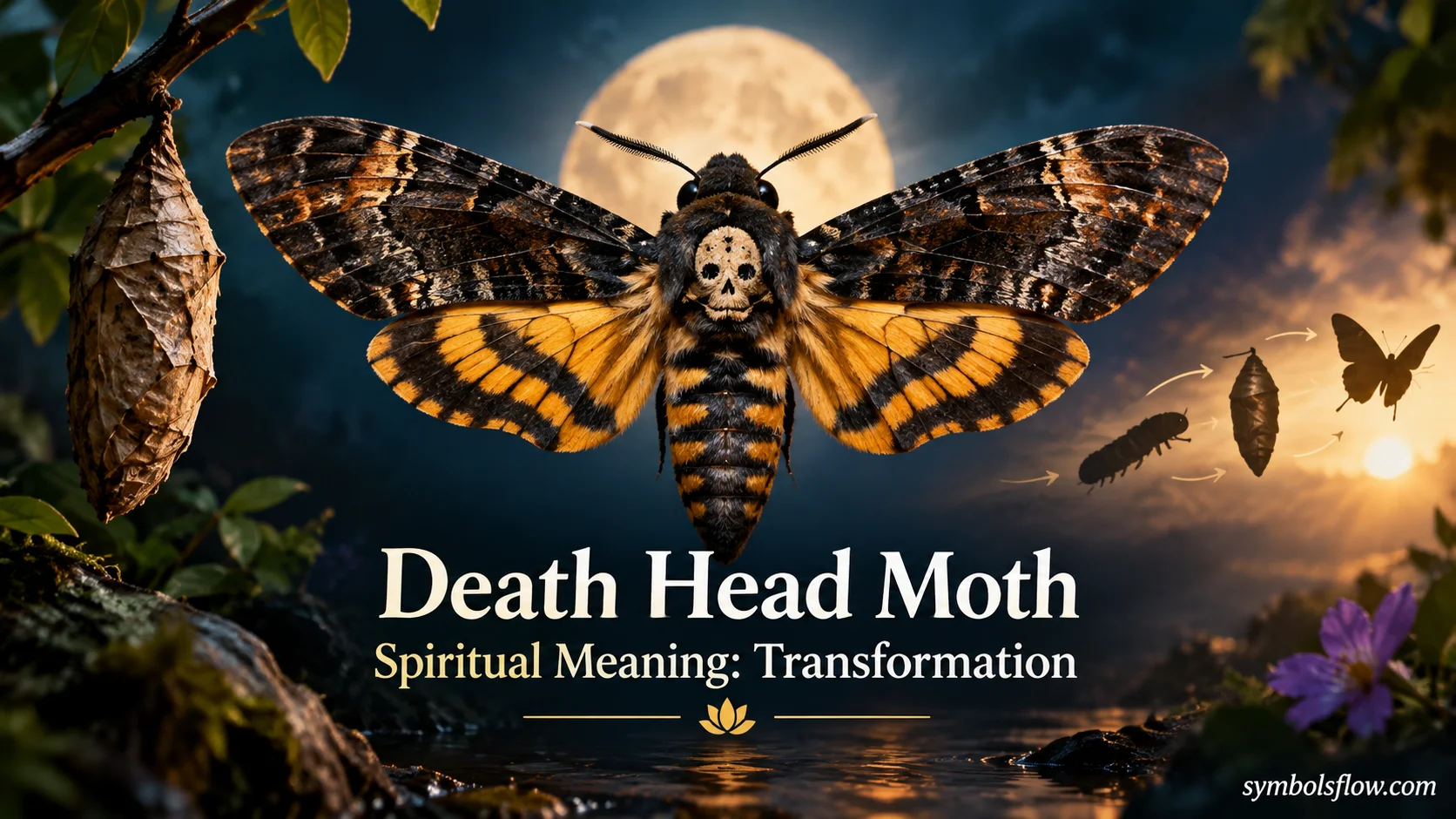
The Death Head Moth Spiritual Meaning: Transformation reflects a moth’s change, mystery, symbolism, and movement through life and personal growth.
The moth moves through the natural world and captures human imagination. The Death’s Head Moth, also called the Death’s Head Hawk Moth, is an intriguing, mysterious, striking creature with skull-like markings, an ominous aura, and an unusual appearance. Its fascination and fear have lasted for centuries, appearing in mythology, art, and popular culture. The skull image has been symbolizing death, while transformation explains its strong reactions. This iconic creature remains an enigma surrounded by mysteries, showing how nature can create wonder and concern. Unlike the brightly-coloured butterfly cousins, moths are often overlooked and misunderstood. In the spiritual world, they carry spiritual meaning as symbols of intuition, vulnerability, and messages from beyond. Spiritual symbolism can make a personal encounter feel like a guide for reflection, not a fixed prediction. Moths can represent change when they keep showing up during an important period of life.
Natural change connects with human symbolism, while the death’s-head hawkmoth adds meaning through its skull-like marking, thorax, dark wings, nighttime activity, and unusual squeaking sound. In the United States, the moth can relate to mortality, mystery, and facing change. Horror films, gothic art, tattoos, and modern spiritual writing have shaped this image. Its complicated history shows that it is more than a simple “death symbol.” The life cycle demonstrates biological transformation, while the skull-like marking became linked with European folklore, death, and misfortune. A balanced interpretation allows the moth to represent an ending without treating an ending as final. Its movement can reflect a natural process of leaving an old stage and becoming ready for what comes next.
“Let’s dive in!
Quick Answer
Death Head Moth Spiritual Meaning: Transformation usually represents major change, personal growth, mortality, and renewal. In the USA, it often combines gothic ideas about death with the moth’s natural process of metamorphosis.
TL;DR
- The death’s-head hawkmoth has a naturally skull-like marking.
- Its strongest modern meaning is transformation through change.
- European folklore often connected it with death and misfortune.
- American culture added strong gothic and horror associations.
- Spiritual interpretations often focus on rebirth and personal growth.
- Modern tattoos use it to express mortality, resilience, and change.
What Is the Death Head Moth?
The death’s-head hawkmoth is a large moth in the genus Acherontia. Three closely related species are commonly known by the death’s-head hawkmoth name.
Its most recognizable feature is a pale marking on the thorax that resembles a human skull. Its upper wings are usually dark and mottled, while the hind wings can show yellow, orange, or cream tones.
Why Does It Look Like a Skull?
The skull appearance comes from the natural arrangement of scales and hairs on the moth’s thorax. Human observers naturally recognize the pattern as a face or skull.
However, the moth isn’t literally carrying a human skull. The appearance is a striking example of how humans find familiar shapes in nature.
Other Striking Features
The moth also has unusual behaviors that helped build its mysterious reputation:
• It is mainly active during nighttime hours.
• Some species produce a distinctive squeaking sound.
• Adults can enter honeybee colonies to feed on honey.
• Its large body makes it especially noticeable among moths.
• Its caterpillar undergoes a dramatic change before adulthood.
Because of these features, the moth naturally attracts attention. Over time, people added cultural meanings to its unusual appearance.
What Does the Death Head Moth Symbolize?
The death head moth can symbolize several connected ideas. These meanings depend heavily on personal beliefs and cultural context.
Transformation and Rebirth
The moth’s life cycle provides the clearest foundation for transformation symbolism. A caterpillar grows, forms a pupa, and eventually emerges as a winged adult.
Therefore, the moth can represent leaving an earlier identity behind. For many modern readers, this makes it a symbol of personal growth.
Mortality and Impermanence
The skull marking naturally connects the moth with mortality. It can remind people that life changes and that nothing remains exactly the same forever.
Rather than meaning literal death, the image can represent the temporary nature of a particular stage of life.
Mystery and the Unknown
Because the moth flies at night, it can also symbolize hidden things. Its darkness may represent questions, uncertainty, intuition, or experiences that aren’t fully understood.
For some people, that mystery feels frightening. For others, it represents curiosity and courage.
Death Head Moth Historical Meaning
The moth’s strongest historical symbolism developed in Europe, especially from the early modern period onward. Its skull-like marking made it an easy subject for folklore and superstition.
European Folklore
In parts of Europe, seeing a death’s-head hawkmoth was sometimes interpreted as a warning of death, illness, war, or other misfortune. Historical accounts describe strong fear surrounding the insect.
Its squeaking sound made the creature even more unusual. People who didn’t understand its biology could easily interpret the sound as something supernatural.
The moth was therefore treated differently from many ordinary insects. Its appearance seemed to combine an animal with an unmistakable human symbol of mortality.
Greek Names and Death Imagery
The scientific name also adds to its dark reputation. Acherontia refers to Acheron, a river associated with the Greek underworld.
The species name atropos refers to Atropos, one of the three Fates in Greek mythology. Atropos was traditionally associated with cutting the thread of life.
However, this doesn’t mean ancient Greeks had a spiritual tradition specifically about the death’s-head moth. The scientific names were assigned much later, drawing on existing Greek mythology.
Literature and Art
The moth eventually became part of European gothic imagery. It appeared in literature and visual art because its natural appearance already suggested themes of death and mystery.
Later works such as Bram Stoker’s Dracula helped strengthen its literary reputation. This history eventually influenced modern horror culture.
Death Head Moth Spiritual Meaning in America
The death’s-head hawkmoth has a different cultural position in the United States. It isn’t a native North American symbol with one widely established traditional meaning.
Instead, Americans usually encounter the image through books, movies, artwork, tattoos, online symbolism, and gothic culture.
Gothic American Symbolism
In modern American culture, the moth often represents a mixture of darkness and beauty.
Its skull marking creates an immediate connection with mortality. Yet its wings and metamorphosis introduce another message: change is possible.
This contrast makes the moth appealing to people who want symbolism that isn’t simply cheerful or simple.
Horror and Popular Culture
The death’s-head hawkmoth became especially recognizable through The Silence of the Lambs. The moth is strongly connected with the film’s disturbing imagery and themes of transformation.
That association influenced how many Americans recognize the insect today. As a result, some people see the moth primarily as a horror symbol rather than a spiritual one.
Still, modern personal interpretations can differ greatly from its cinematic use.
Death Head Moth Symbolism Across Cultures
The moth’s meanings shouldn’t be treated as universal. Different cultures have developed different relationships with moths, butterflies, death, and transformation.
Life, Soul, and Metamorphosis
Across several ancient traditions, butterflies and other winged insects could become connected with the soul because of their dramatic transformation.
Ancient Greek language provides one famous example. The word psyche could refer to the soul as well as a butterfly.
However, this broad butterfly symbolism should not be confused with a specific ancient Greek tradition about the death’s-head hawkmoth.
Spiritual Transformation
Modern spiritual writers often interpret the death’s-head moth as a guide through major life changes.
Common interpretations include:
• Leaving behind an outdated identity.
• Accepting change instead of resisting it.
• Finding meaning after difficult experiences.
• Facing mortality with greater awareness.
• Entering an unfamiliar stage of life.
• Turning fear into personal strength.
These are modern symbolic interpretations, not universal religious teachings.
Death Head Moth Meaning in Dreams
Dream symbolism is highly personal, but a death’s-head moth can create strong associations.
Seeing the Moth in a Dream
A dream involving the moth may reflect thoughts about change, uncertainty, endings, or hidden fears. The skull marking can make the dream feel especially intense.
However, seeing this insect doesn’t establish that something bad will happen. Dreams are shaped by memories, emotions, media, and personal experiences.
A Moth Flying Toward You
A moth approaching you may be interpreted symbolically as an issue demanding attention. If you’re currently facing a major transition, the image may feel especially meaningful.
The interpretation can also depend on your emotional response. Feeling calm suggests a different personal association than feeling frightened.
Death Head Moth Psychological Meaning
The moth has strong psychological symbolism because it combines two opposing images.
On one side, the skull suggests death, endings, and fear. On the other, the moth’s transformation suggests growth and renewal.
The Symbol of Facing Fear
For some people, the moth represents confronting something uncomfortable. Instead of avoiding darkness, the symbol encourages awareness of it.
This doesn’t mean the moth has a scientifically proven psychological message. Rather, people can use symbols to express their own emotional experiences.
Mortality Awareness
The skull can also function as a reminder of impermanence. Similar imagery appears in the broader tradition of memento mori, which encourages awareness that human life is temporary.
The moth adds another layer to that idea. Its life cycle suggests that an ending can also be part of a larger process of change.
Death Head Moth Tattoo Meaning
Death’s-head moth tattoos are popular within gothic, alternative, and nature-inspired tattoo styles. Their meaning can range from dark aesthetics to deeply personal transformation.
Common Tattoo Associations
A person choosing this design might connect it with:
• Personal transformation after a difficult period.
• Acceptance of mortality and impermanence.
• Strength during an uncertain transition.
• Attraction to gothic or dark natural imagery.
• Rebirth after leaving an old identity behind.
• A fascination with insects and natural history.
The meaning ultimately belongs to the person wearing it. A tattoo doesn’t have one fixed interpretation.
Skull and Moth Together
The skull and wings create a deliberate contrast. The skull suggests an ending, while the wings suggest movement and freedom.
That combination can communicate a simple idea: change can grow from endings.
Death Head Moth in Modern American Culture
Today, the death’s-head moth appears far beyond folklore. Its distinctive shape makes it useful in visual design and personal expression.
Fashion and Decor
The image works particularly well in gothic and alternative aesthetics. It can appear on clothing, jewelry, posters, artwork, and decorative objects.
Its natural pattern also appeals to people who enjoy unusual insects. For others, the skull creates a darker Halloween atmosphere.
Social Media and Digital Art
Online, the moth can represent transformation, mystery, darkness, or individuality. Artists may exaggerate the skull marking or combine it with flowers, moons, flames, or other imagery.
These combinations are usually modern artistic choices. They shouldn’t automatically be presented as ancient symbolic traditions.
Read More: Fire in Eyes Spiritual Meaning: Passion or Anger
Death Head Moth Symbolism by Context
The same image can communicate very different ideas depending on where it appears. Context matters especially in American culture, where gothic, spiritual, artistic, and scientific interpretations overlap.
| Context | Meaning in the USA | Common Associations | Notes |
| Spiritual artwork | Transformation | Renewal, change, mystery | Usually a modern interpretation |
| Tattoo | Personal change | Mortality, resilience | Meaning depends on the wearer |
| Gothic design | Darkness | Skulls, night, mystery | Often influenced by horror culture |
| Nature artwork | Metamorphosis | Moths, ecology, life cycles | Focuses more on biology |
| Halloween decor | Death imagery | Fear, ghosts, mortality | Often playful rather than spiritual |
| Horror media | Danger or mystery | Suspense, darkness | Strongly shaped by popular culture |
Why Is the Death Head Moth Associated With Death?
The association is mainly visual and historical. Its thorax resembles a skull, and skulls have long been recognizable symbols of mortality.
Historical European folklore strengthened the connection. Some communities treated sightings as warnings of death or disaster.
The Important Distinction
The moth itself doesn’t predict death. There is no scientific evidence that seeing one signals an upcoming tragedy.
Instead, the death association comes from human interpretation. People see a skull-like pattern and connect it with a symbol they already understand.
This distinction is important when discussing spiritual symbolism responsibly.
Is the Death Head Moth a Symbol of Transformation?
Yes, transformation is one of its strongest modern symbolic interpretations. The biological reason is straightforward: moths undergo metamorphosis.
From Caterpillar to Moth
The caterpillar represents an earlier stage of development. The pupa represents an enclosed transition, while the adult moth represents a radically different form.
This process makes the moth a natural metaphor for change.
In spiritual writing, the symbolism can therefore suggest:
• Growth after an important life transition.
• Releasing habits that no longer fit.
• Accepting uncertainty during personal change.
• Discovering strength after hardship.
• Moving into a new identity.
The spiritual meaning is metaphorical. The biological transformation itself is real.
Misunderstandings and Controversies
The death’s-head moth has accumulated many dramatic stories. Some are based on historical folklore rather than scientific evidence.
Does the Moth Cause Death?
No. The moth doesn’t cause death by appearing near someone.
Historical stories sometimes treated it as an omen. Today, those stories are best understood as examples of folklore rather than evidence of supernatural power.
Is the Moth Dangerous?
The adult death’s-head hawkmoth is not known as a dangerous insect to people. Its frightening appearance has contributed greatly to its reputation.
Its ability to enter beehives is much more biologically unusual than any threat it poses to humans.
Horror Isn’t the Whole Meaning
American media often emphasizes the moth’s frightening appearance. However, that is only one layer of its symbolism.
The same image can represent mortality, beauty, adaptation, curiosity, and transformation.
How the Death Head Moth Meaning Has Changed
The moth’s symbolic history shows a clear shift from fear toward more complex interpretations.
Earlier Interpretations
Older European folklore often emphasized death, illness, bad luck, and supernatural fear. The skull marking made these associations easy to understand.
Later gothic literature and art preserved much of that darkness.
Modern Interpretations
Today, transformation has become an important addition. People increasingly use the moth to describe personal change rather than literal death.
The symbol can therefore hold two ideas at once: something is ending, and something new is developing.
What Does Seeing a Death Head Moth Mean Spiritually?
For someone who uses spiritual symbolism, seeing the moth may serve as a personal reminder of transition. It can encourage reflection on what is changing and what may need to be released.
However, there is no single spiritual message that applies to everyone. Your surroundings, emotions, and personal beliefs can shape what the encounter means to you.
A Reflective Interpretation
You might ask yourself:
• What part of my life is changing right now?
• What old pattern am I ready to release?
• What uncertainty am I learning to accept?
• What have I learned from a recent ending?
• Where could I allow myself to grow?
These questions keep the symbolism personal rather than treating the moth as a prediction.
FAQs:
1. What is the Death Head Moth Spiritual Meaning: Transformation?
The Death Head Moth Spiritual Meaning: Transformation is often linked with personal change, endings, renewal, mystery, and moving from one stage of life into another.
2. Does a Death Head Moth symbolize death?
The Death Head Moth can symbolize death because of its skull-like marking and long connection with European folklore. In spiritual symbolism, it can also represent transformation rather than literal death.
3. What does seeing a Death Head Moth mean spiritually?
Seeing a Death Head Moth may be viewed as a symbolic reminder to face change, release an old chapter, trust your intuition, and stay open to personal growth.
4. Why is the Death Head Moth associated with transformation?
Its life cycle naturally involves major biological changes. This process has made the moth a useful spiritual symbol for endings, renewal, personal development, and transformation.
5. Is seeing a Death Head Moth a bad spiritual sign?
Not necessarily. Spiritual interpretations vary, and there is no universal rule that seeing this moth means something negative. Many people view it as a symbol of change, awareness, resilience, and new beginnings.
Conclusion:
The Death Head Moth carries a striking mix of mystery, death symbolism, and transformation. Its skull-like marking has inspired fear and fascination, while its natural life cycle offers a different perspective on change. For many people, the moth represents the closing of one chapter and the opening of another. Its spiritual meaning can encourage reflection, acceptance, and courage when life feels uncertain. These interpretations belong to folklore and personal symbolism rather than fixed spiritual rules.

1 thought on “Death Head Moth Spiritual Meaning: Transformation”