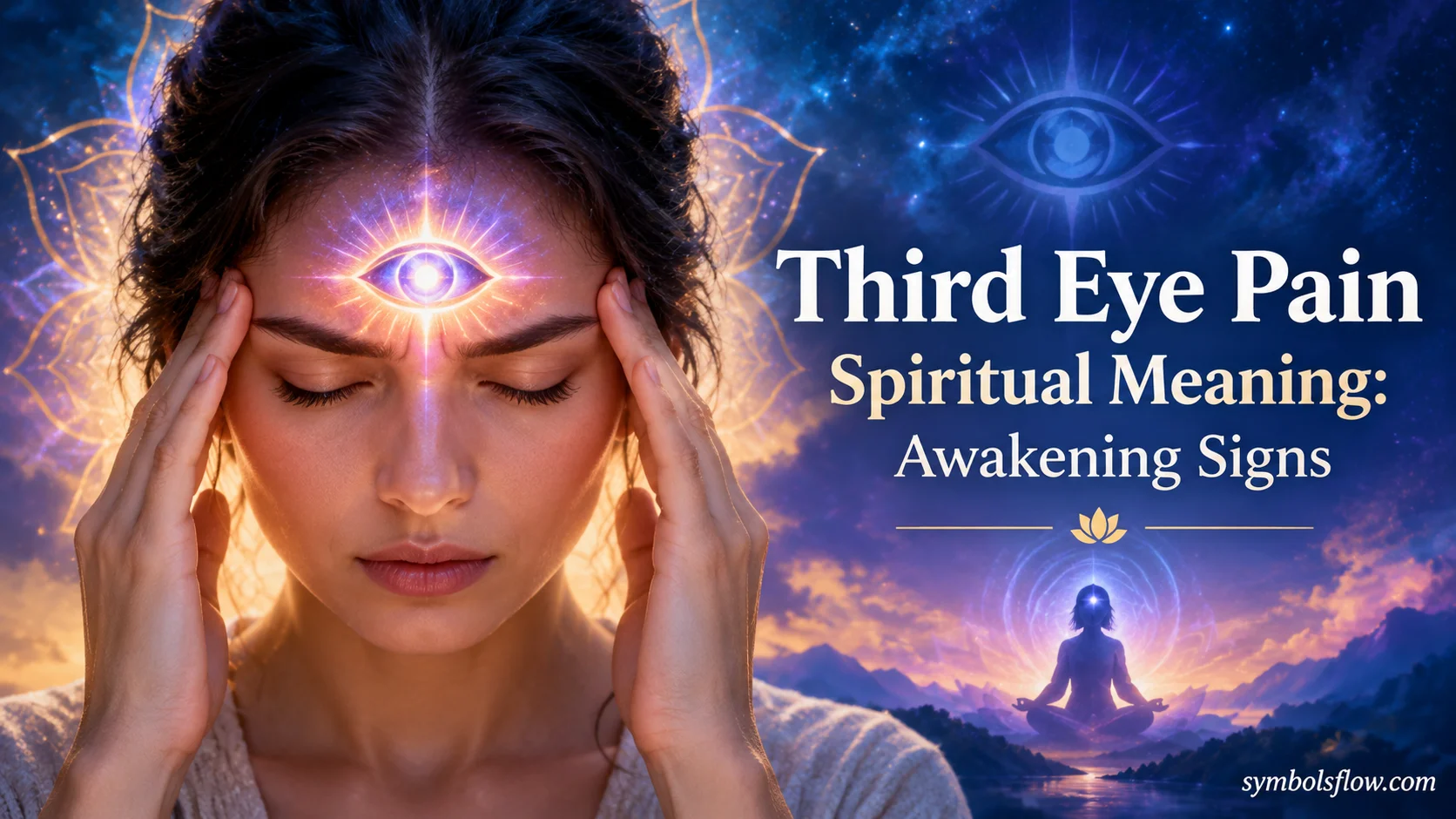
Third Eye Pain Spiritual Meaning: Awakening Signs may relate to pressure between the eyebrows during meditation and signs of spiritual awakening.
The third eye is linked with opening, third eye awakening, dreams that become startlingly vivid, strong intuition, and unusual precision in inner feelings. These experiences can feel meaningful rather than random, with signs, inner perception, and spiritual signs becoming easier to notice. The third eye chakra, known as the Ajna chakra, is an energy center connected with intuition, insight, inner wisdom, and the ability to see beyond the physical world toward deeper truths about life.
A blocked third eye chakra may be associated with physical imbalances, emotional imbalances, and spiritual imbalances in spiritual traditions. The dark purple chakra represents awareness, perception, and reflection. Symptoms linked with blocked third eye chakra symptoms can include a third eye headache or headache, while physical health and mental health still deserve proper attention. Chakra blockage and energy blockage may be connected with confusion, doubt, and lack of direction in spiritual interpretations. Physical and mental imbalances, emotional health, spiritual health, spiritual balance, emotional balance, and physical balance can shape how someone understands their third eye meaning and chakra meaning.
“Let’s dive in!
Quick Answer
Third Eye Pain Spiritual Meaning: Awakening Signs is commonly interpreted as increased intuition, inner awareness, emotional reflection, or spiritual awakening. In broader spiritual traditions, the third eye represents inner vision rather than ordinary physical sight.
TL;DR
- Third eye symbolism centers on intuition, insight, and inner awareness.
- Pain or pressure is sometimes interpreted as spiritual awakening.
- Ancient South Asian traditions give the third eye deeper religious meanings.
- Modern American spirituality often connects it with meditation and self-discovery.
- The pineal gland is related to sleep biology, not proven spiritual perception.
What Does Third Eye Pain Symbolize?
The Symbolic Meaning
The area between the eyebrows has become strongly associated with inner vision. In spiritual language, the third eye is imagined as a way of noticing what ordinary sight misses.
Therefore, sensations in this area may become symbolic of increased attention or awareness. Some people describe the experience as a reminder to slow down and examine their thoughts.
Common spiritual interpretations include:
- Greater awareness of personal thoughts and emotions
- Increased attention to intuition and inner feelings
- A period of reflection or spiritual questioning
- A symbolic transition toward greater self-understanding
- A desire to notice patterns in life more carefully
These meanings are interpretations, not universal rules. Spiritual traditions don’t all describe third eye sensations in the same way.
Why Do People Connect Pain With Awakening?
The Idea of Spiritual Activation
Modern spiritual communities often use the word “awakening” to describe a period of increased awareness. During such periods, people may pay closer attention to dreams, emotions, meditation, relationships, or personal beliefs.
Because the third eye symbolizes inner perception, a sensation around the forehead can become part of that story. The sensation itself may feel meaningful because the person is already focused on personal transformation.
However, spiritual interpretation and physical sensation are different things. A forehead sensation doesn’t by itself establish that a chakra has opened or that an awakening has occurred.
Pressure During Meditation
Focused meditation can make people more aware of subtle sensations. When attention remains on the brow area, normal sensations may become easier to notice.
Some spiritual teachers interpret this as concentration around the third eye. Others simply treat it as an effect of focused attention.
What Is the Historical Meaning of the Third Eye?
Ancient South Asian Roots
The third eye has especially important roots in Hindu religious imagery and yogic traditions. The concept became associated with inner perception, spiritual knowledge, concentration, and deeper awareness.
The Sanskrit term ajna is commonly associated with the brow or sixth chakra in modern chakra systems. Yet the modern idea of a universal “third eye chakra” should not be projected unchanged onto every historical Hindu text.
The symbolism also appears in representations of Shiva. His forehead eye can express extraordinary vision, divine power, and the ability to destroy illusion.
Buddhist Imagery
Buddhist art also developed important forehead symbolism. The urna, a mark between the eyebrows, is associated with the Buddha’s distinctive physical signs in Buddhist artistic traditions.
However, the urna shouldn’t automatically be treated as identical to the modern New Age concept of a third eye. Similar-looking symbols can have different meanings within different traditions.
What Does Shiva’s Third Eye Mean?
Wisdom and Destruction of Illusion
Shiva’s third eye is one of the best-known examples of forehead-eye symbolism. In Hindu iconography, it can represent extraordinary perception and an all-seeing quality.
It also has a powerful destructive dimension. In stories associated with Shiva, the opening of his third eye can produce transformative fire.
This makes the symbol more complex than simple intuition. It can represent the destruction of illusion, transformation, spiritual power, and awareness.
Why This Matters Today
Modern artwork often simplifies Shiva’s third eye into a general symbol of spiritual awakening. That interpretation can be meaningful personally, but it doesn’t capture the full religious context.
Understanding the traditional background helps preserve the distinction between devotional imagery and modern decorative spirituality.
What Does the Third Eye Mean in Buddhism?
Inner Wisdom and Awareness
Buddhist traditions contain several forms of forehead and eye symbolism. Buddhist art can use the urna as a distinctive mark associated with awakened beings.
Some Buddhist traditions also use language involving wisdom, insight, or extraordinary perception. Still, Buddhist teachings vary widely across regions and schools.
For American readers, the key point is simple: Buddhist forehead imagery has its own religious history. It shouldn’t automatically be reduced to the modern idea of “activating your chakra.”
What Does the Third Eye Mean in America?
Modern American Spirituality
In the United States, the third eye has become a familiar symbol within contemporary spirituality and wellness culture. It’s commonly seen in meditation spaces, artwork, jewelry, clothing, tattoos, and online spiritual communities.
American interpretations often emphasize personal intuition rather than a specific religious doctrine. The symbol can therefore function as a visual shorthand for self-awareness.
| Context | Meaning in the USA | Common Associations | Notes |
| Meditation | Inner awareness | Focus, reflection | Often connected with brow-focused meditation |
| Tattoos | Intuition and insight | Personal growth | Meaning varies by design and wearer |
| Jewelry | Spiritual identity | Protection, awareness | Often paired with crystals or lotus imagery |
| Home decor | Mindfulness | Peace, contemplation | Common in wellness-inspired spaces |
| Social media | Awakening | Intuition, transformation | Meanings can become highly personalized |
American Pop Culture
The symbol also appears in music, fashion, fantasy art, and alternative wellness communities. Its recognizable shape makes it easy to use visually.
As a result, the third eye can mean spirituality without belonging to one particular religion. This flexibility is one reason it remains popular.
What Are the Cross-Cultural Spiritual Meanings?
Different Traditions, Different Contexts
Third-eye-like imagery appears across multiple cultures and religious settings. Yet these traditions shouldn’t be treated as interchangeable.
In Hindu contexts, forehead symbolism can connect with deities, yoga, meditation, and spiritual perception. In Buddhist art, related imagery can communicate wisdom or the special qualities of awakened beings.
Taoist and Western esoteric traditions also contributed to modern ideas about inner sight. Later Western occult movements helped reshape the third eye into a broader symbol of hidden knowledge and intuition.
Shared Themes
Across these different contexts, several broad themes appear:
- Looking beyond surface appearances
- Developing deeper awareness
- Seeking wisdom through contemplation
- Connecting perception with spiritual understanding
- Moving from ordinary awareness toward deeper reflection
The similarities are useful, but historical differences still matter.
What Does Third Eye Pain Feel Like Spiritually?
Common Spiritual Interpretations
People who use spiritual language may describe the experience as pressure, tingling, warmth, pulsing, heaviness, or a sensation of movement.
Within spiritual communities, these sensations are sometimes interpreted as signs of increased awareness. Some people connect them with meditation, vivid dreams, intuition, emotional release, or a perceived shift in consciousness.
However, these interpretations aren’t universal. A sensation around the forehead cannot independently prove that a spiritual awakening is taking place.
Symbolic Versus Physical Meaning
The most balanced approach is to keep two ideas separate. A person can find personal spiritual meaning in an experience without claiming that the physical sensation has been scientifically established as a spiritual event.
This distinction is especially important when discussing pain. Symbolic traditions can describe what an experience means to someone, but they don’t establish the physical cause of a sensation.
Read More: Dark-Eyed Junco Spiritual Meaning: Modesty & Clarity
What Are Common Third Eye Awakening Signs?
Signs Mentioned in Modern Spirituality
Modern spiritual communities often describe awakening through changes in awareness rather than one single physical symptom.
Frequently mentioned experiences include:
- More vivid or memorable dreams
- Stronger interest in meditation and self-reflection
- Increased attention to intuition
- Greater awareness of emotional patterns
- A feeling of seeing familiar situations differently
- Increased interest in spiritual questions
Some people also describe forehead pressure or tingling. Yet these reports belong to spiritual interpretation rather than a universally accepted diagnostic system.
Awakening as a Personal Metaphor
For some people, “awakening” simply describes becoming more conscious of their values and behavior. It doesn’t necessarily mean supernatural perception.
That broader interpretation can make the idea useful even for people who don’t follow a particular spiritual tradition.
What Is the Psychological Meaning of Third Eye Pain?
Introspection and Attention
The third eye can work as a powerful psychological metaphor. It represents the ability to look inward and notice thoughts, habits, emotions, and assumptions.
When people focus on the symbol, they may naturally become more reflective. In this sense, “inner vision” can describe self-awareness without requiring a supernatural explanation.
Emotional Transformation
Modern spiritual language often connects awakening with emotional change. Someone may begin questioning old beliefs, changing priorities, or becoming more aware of unresolved feelings.
The third eye then symbolizes a new perspective. It suggests learning to observe rather than automatically react.
How Is the Third Eye Used Today?
Tattoos and Jewelry
Third-eye tattoos are popular because the image communicates a clear idea with very little text. Designs often include lotus flowers, geometric shapes, moons, stars, or radiating lines.
Some people choose the symbol for intuition or spiritual growth. Others simply appreciate its visual meaning.
Social Media and Online Spirituality
Online communities have helped turn the third eye into a widely recognizable spiritual symbol. Terms such as “third eye awakening” and “third eye activation” are often used in posts about meditation, dreams, intuition, and personal transformation.
However, online explanations can blend traditions together. A viral interpretation may therefore reflect modern internet spirituality more than an ancient religious teaching.
Home Decor and Personal Identity
Third-eye artwork may appear in meditation rooms, wellness spaces, clothing, posters, and decorative objects.
For many Americans, the symbol communicates mindfulness, curiosity, spiritual openness, or interest in alternative traditions. Its meaning ultimately depends on the person and context.
Is the Third Eye Connected to the Pineal Gland?
Where the Connection Came From
Modern spiritual writing frequently connects the third eye with the pineal gland. This association became especially influential through Western philosophical and esoteric traditions.
The pineal gland has also fascinated people because of its central location and relationship with light and biological rhythms. Historical writers gave it philosophical meanings that later became mixed with spiritual ideas about inner perception.
What Biology Shows
The pineal gland is a real endocrine structure in the brain. Its best-established role involves producing melatonin and helping regulate circadian rhythms, including the body’s sleep-wake cycle.
That biological function is different from the spiritual concept of the third eye. Therefore, saying that the pineal gland is literally a spiritual eye goes beyond established anatomy.
What Are Common Misunderstandings About Third Eye Pain?
Pain Does Not Prove Spiritual Awakening
One common misunderstanding is that forehead pain automatically means a chakra is opening. Spiritual traditions don’t provide one universal test that confirms such an event.
Likewise, not having forehead sensations doesn’t mean someone lacks intuition or spiritual awareness.
Similar Symbols Aren’t Always Identical
Another misunderstanding is treating every forehead mark as the same third-eye symbol. The Shiva eye, Buddhist urna, Hindu forehead markings, and modern third-eye artwork developed within different contexts.
Recognizing those differences makes the symbolism more accurate and respectful.
The Eye of Providence Is Different
The Eye of Providence is sometimes confused with the third eye because both use eye imagery. However, the American Eye of Providence has a different historical development and shouldn’t automatically be labeled a third-eye symbol.
How Has Third Eye Symbolism Changed Over Time?
From Religious Imagery to Personal Spirituality
Historically, third-eye symbolism was closely connected with religious and philosophical traditions. Over time, Western esoteric movements broadened the concept.
In contemporary America, the third eye is often presented as a personal symbol. It may represent intuition, mindfulness, self-discovery, creativity, or spiritual curiosity rather than formal religious belief.
From Sacred Symbol to Pop Culture Image
Today, the symbol can appear in serious religious contexts and casual commercial designs. That wide use has made its meaning more flexible.
At the same time, simplification can remove important historical details. A modern design may use the third eye simply because it looks mystical.
FAQs:
1. What is the spiritual meaning of third eye pain?
In spiritual traditions, third eye pain or pressure between the eyebrows may be interpreted as a sign of third eye awakening, increased.
2. Is a third eye headache a sign of spiritual awakening?
Some spiritual beliefs connect a third eye headache with third eye activation or changes in awareness.
3. What are common blocked third eye chakra symptoms?
Spiritual traditions may associate a blocked third eye chakra with confusion, doubt, poor focus, lack of directio.
4. How can I balance my third eye chakra?
Practices such as meditation, quiet reflection, journaling, grounding exercises, mindful breathing.
5. What does the third eye symbolize?
The third eye, or Ajna chakra, is traditionally associated with intuition, insight, inner wisdom, perception, and deeper understanding.
Conclusion:
Third Eye Pain Spiritual Meaning: Awakening Signs can be understood through the traditions surrounding the third eye chakra, intuition, inner perception, and spiritual awareness. Pressure between the eyebrows, vivid dreams, stronger intuition, or emotional changes may feel meaningful during periods of personal growth. Spiritual interpretations can provide a framework for reflection, but they are not fixed rules or medical explanations. A balanced approach combines spiritual practices with practical care for physical and mental health. Meditation, grounding, journaling, and mindful observation can help you explore these experiences with greater clarity. The deeper purpose of third eye work is not simply to experience unusual sensations, but to develop greater awareness, wisdom, and understanding of yourself.

1 thought on “Third Eye Pain Spiritual Meaning: Awakening Signs”