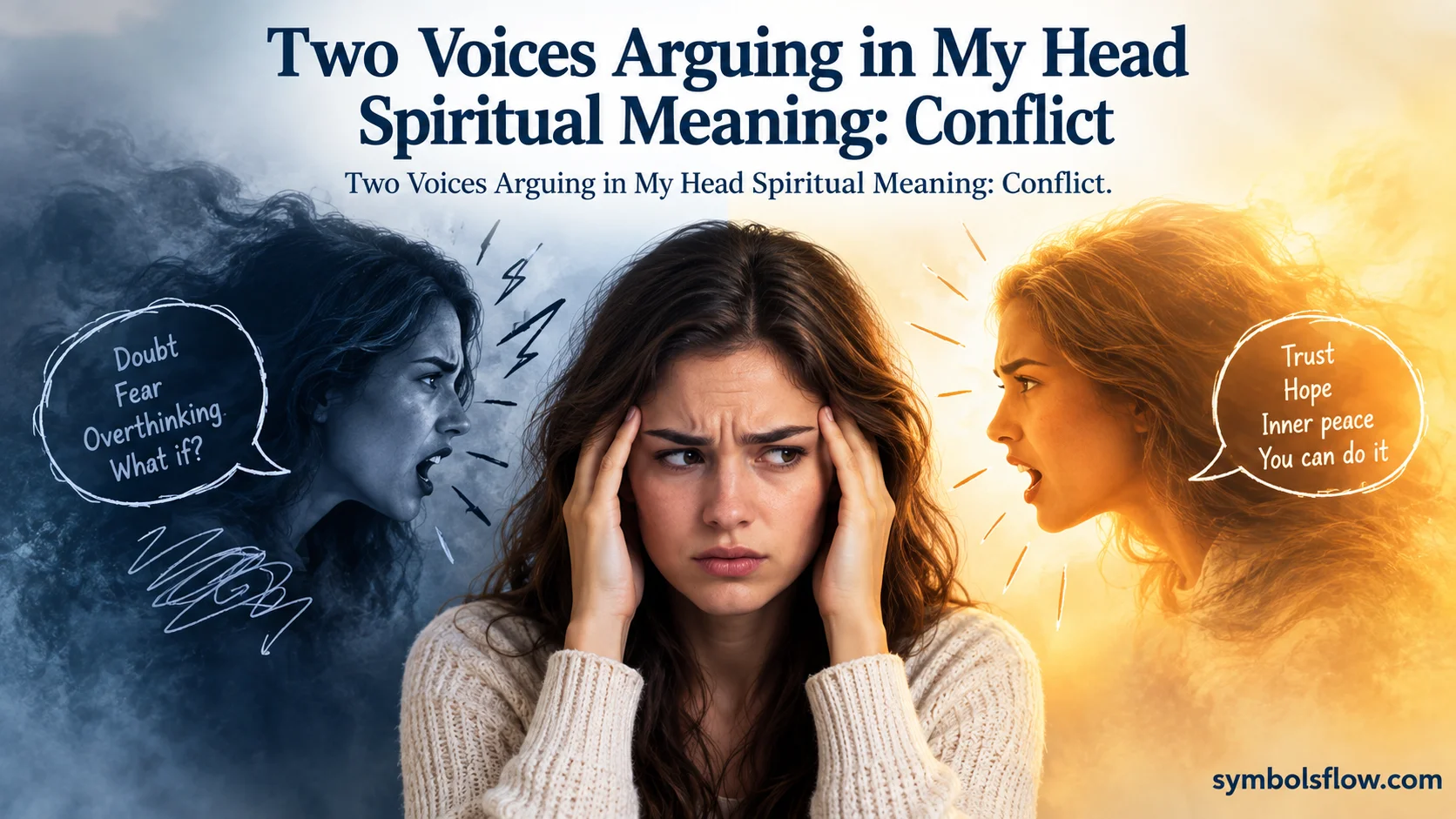
Two Voices Arguing in My Head Spiritual Meaning: Conflict can reflect inner debate, competing thoughts, fear, courage, and a search for balance.
The mind thinks, says, and keeps talking, creating a sense that two different sides are having an argument. One side may say Go for it, while another says Wait. Most people face competing thoughts, opposing thoughts, or inner dialogue during everyday life, major choices, relationships, career changes, and uncertainty. People may hide what the mind thinks because they fear that other people may see their stuff as weird or crazy.
Judgment, embarrassment, and unwanted reactions can keep hidden thoughts private. The result may be carrying fear, shame, emotional burden, and a burdened mind, making it harder to deal with thoughts and emotions effectively. Fear of judgment can deepen mental conflict, psychological conflict, and an inner experience involving mental thoughts, self-talk, and internal voices. Some people become convinced that the voices in their head are part of their own thinking, while others describe screaming or persistent inner voices.
“Let’s dive in!
Quick Answer
Two Voices Arguing in My Head Spiritual Meaning: Conflict often symbolizes an inner struggle between competing beliefs, emotions, desires, or life directions. In the USA, it’s commonly interpreted as a sign to slow down, examine your values, and seek balance rather than simply choosing one side.
TL;DR
- Two voices can symbolize inner conflict and competing life choices.
- Spiritually, they may represent intuition versus fear or old beliefs versus growth.
- American culture often connects inner dialogue with self-discovery and personal choice.
- Psychology describes many forms of inner speech and internal dialogue.
- The conflict can become an opportunity for reflection and emotional growth.
- Meaning depends on context, feelings, beliefs, and the nature of the experience.
What Does Two Voices Arguing in Your Head Symbolize?
Two arguing voices can represent different parts of your inner world. One may support change, while another prefers safety, familiarity, or control.
For many people, the argument becomes noticeable when an important decision creates emotional pressure. The mind then compares different possibilities before settling on a direction.
A Symbol of Inner Conflict
The most common spiritual interpretation is conflict within the self. The two voices may symbolize opposing needs that both feel important.
For example, one side may want independence while another wants security. Neither side has to be “bad.” Each may be protecting something meaningful.
A Symbol of Duality
Two voices can also represent duality. Many spiritual traditions use paired opposites to describe human experience.
Common symbolic pairs include:
• Fear and courage
• Logic and intuition
• Past and future
• Security and freedom
• Desire and responsibility
• Individual needs and social expectations
The deeper message may not be about defeating one side. Instead, it can involve understanding why both sides exist.
Is Two Voices Arguing a Sign of Inner Conflict?
Yes, in a symbolic sense, two opposing inner perspectives can point toward unresolved conflict. Psychological research also recognizes internal dialogue as a normal form of self-related thinking.
This conflict often becomes stronger when your beliefs and actions don’t fully match. Cognitive dissonance describes the discomfort that can arise when important thoughts or beliefs conflict.
When Your Values Clash
Imagine someone who values financial stability but also dreams of changing careers. One inner perspective may emphasize responsibility, while another emphasizes fulfillment.
Neither perspective automatically represents truth. Instead, the argument reveals a deeper question about priorities.
When Your Past Meets Your Future
Sometimes the conflict reflects a transition between identities.
An older version of you may prefer familiar routines. A newer version may want something different. The tension can feel like an argument because both perspectives are competing for attention.
Spiritual Meaning of Two Voices Arguing in Your Head
Spiritual interpretations often treat the experience as a metaphor for awareness, transformation, or alignment. These interpretations aren’t universal beliefs, but they can provide a reflective framework.
One modern spiritual interpretation describes the voices as a struggle between ego, intuition, fears, desires, and a person’s sense of higher purpose.
Ego and Intuition
In many modern spiritual discussions, the ego represents the part concerned with safety, status, approval, or immediate desires.
Intuition is often described as a quieter sense of knowing. However, spiritual traditions differ widely on what intuition means, so it shouldn’t automatically be treated as supernatural guidance.
A Call for Alignment
The argument may symbolically ask:
“What do I actually value?”
That question can be more useful than asking which voice is automatically right. The goal may be greater alignment between your choices, values, emotions, and actions.
Two Voices and the Meaning of Spiritual Conflict
Spiritual conflict doesn’t necessarily mean something negative is happening. Sometimes conflict appears during periods of significant personal change.
A person may feel pulled between an old identity and a developing one. In that sense, the argument can symbolize a doorway between two stages of life.
Conflict Before Transformation
Many spiritual frameworks view transformation as involving uncertainty. Before a new direction feels natural, the old direction may continue pulling you back.
This creates an emotional middle ground. You know something needs to change, yet you aren’t completely ready.
The Shadow Side
Some spiritual interpretations use the idea of a “shadow” to describe hidden fears, rejected emotions, or traits a person struggles to accept.
The two voices can therefore symbolize a meeting between the part you show others and the part you usually keep private.
The useful lesson isn’t to label one voice as evil. Instead, it can encourage honest self-examination.
Historical Roots of Inner Voices and Inner Dialogue
The idea of inner conflict is much older than modern psychology. Philosophers and religious thinkers have long explored the experience of questioning oneself, weighing choices, and debating competing impulses.
Ancient Greek philosophy, for example, explored reason, desire, virtue, and the struggle involved in choosing how to live. Later religious traditions developed their own ideas about conscience, temptation, discipline, and moral choice.
Ancient and Pre-Christian Ideas
Ancient stories often presented human beings as caught between competing forces. Heroes faced temptation, duty, desire, fear, fate, and responsibility.
These stories weren’t necessarily descriptions of literal voices. Instead, opposing characters and forces often dramatized struggles taking place inside a person.
Religious Interpretations
Within Christian traditions, inner conflict has often been discussed through ideas such as conscience, temptation, repentance, and moral discernment.
Other religious and philosophical traditions have their own frameworks for understanding competing desires and thoughts. These traditions shouldn’t be reduced to one universal interpretation.
The Modern Shift
Over time, inner conflict increasingly became a subject of philosophy, psychology, literature, and cognitive science.
Modern research describes inner speech as thinking in words and recognizes internal dialogue as one form of self-related mental activity.
What Do Two Voices Mean in American Culture?
In the United States, inner conflict often gets framed through ideas of individuality, choice, personal freedom, and self-improvement.
American movies, books, advertising, and social media frequently portray characters wrestling with two sides of themselves. One side represents the life they have, while another represents the life they want.
Common American Associations
| Context | Meaning in the USA | Common Associations | Notes |
| Major decision | Competing priorities | Choice, uncertainty | Often temporary |
| Career change | Security versus purpose | Ambition, freedom | Can involve identity |
| Relationship conflict | Heart versus reason | Love, boundaries | Context matters |
| Personal growth | Old self versus new self | Change, confidence | Often viewed positively |
| Moral dilemma | Values competing | Conscience, responsibility | No universal answer |
The American emphasis on self-definition can make inner conflict especially relatable. However, people interpret these experiences through many different cultural and spiritual backgrounds.
What Do Two Voices Mean Emotionally?
Emotionally, two arguing voices can symbolize tension that has not yet been resolved. The stronger the disagreement, the more important the underlying issue may feel.
The voices may carry different emotional tones. One could sound protective, while another sounds critical or hopeful.
Fear Versus Courage
Fear often asks you to avoid risk. Courage asks you to move forward despite uncertainty.
Spiritually, this can symbolize a moment when growth requires leaving familiar territory.
Desire Versus Responsibility
Another common conflict involves what you want versus what you believe you should do.
This can happen with relationships, work, family expectations, money, or personal goals. The argument may reveal competing responsibilities rather than a simple right-versus-wrong choice.
Self-Criticism Versus Self-Compassion
One internal voice may constantly point out mistakes. Another may encourage patience and understanding.
Research on self-talk recognizes that internal dialogue can serve different functions, including self-criticism, self-management, reinforcement, and social reflection.
What Does It Mean When One Voice Feels Stronger?
When one side dominates, the symbolic meaning may involve an imbalance between competing needs.
For example, a highly cautious inner perspective may suggest that safety has become extremely important. A constantly ambitious perspective may suggest that achievement has taken priority over rest.
The Loudest Voice Isn’t Always the Wisest
Volume doesn’t prove truth.
A fearful thought can be extremely intense. Likewise, an exciting idea can feel powerful without necessarily being wise.
Instead, consider what each perspective is trying to protect, express, or achieve.
Look Beneath the Argument
Ask yourself:
• What does each side want?
• What is each side afraid of?
• Which personal value does each side represent?
• What past experience may influence the disagreement?
• What outcome would respect both concerns?
These questions can turn an abstract spiritual idea into useful self-reflection.
Two Voices and Intuition Versus Fear
A popular spiritual interpretation connects two opposing voices with intuition and fear. This can be meaningful as a metaphor, but it shouldn’t be treated as a universal spiritual rule.
Intuition is often described as a subtle sense of knowing. Fear, by contrast, tends to focus attention on danger, uncertainty, and possible negative outcomes.
Why They Can Sound Similar
Both intuition and fear can produce strong feelings.
For example, a person might hesitate before accepting a new opportunity. That hesitation could represent healthy caution, anxiety, previous experience, or simple uncertainty.
Because feelings can have multiple causes, reflection matters more than automatically labeling one voice “intuition.”
Finding the Middle Ground
Instead of asking which voice must win, ask:
“What information is each side giving me?”
That approach creates space for caution without allowing fear to control every decision.
Read More: Deep Meaning Finger Tattoos: Symbolism & Spiritual Meanings
Cross-Cultural and Spiritual Meanings
Different cultures have long recognized the experience of inner tension, although they explain it in different ways.
Some spiritual systems emphasize harmony between opposing forces. Others focus on conscience, discipline, contemplation, prayer, meditation, or self-knowledge.
A Respectful Cross-Cultural View
Common themes include:
• Balance between opposing forces
• Awareness of personal desires
• Moral reflection and conscience
• Detachment from impulsive thoughts
• Integration of conflicting emotions
• Growth through self-knowledge
These similarities don’t mean every tradition teaches the same thing. They simply show that inner conflict is a widespread human theme.
Avoiding One Universal Explanation
It’s tempting to say one voice always represents good and another always represents bad.
However, that interpretation can oversimplify real human experience. A cautious voice may protect you, while an ambitious voice may help you grow.
The meaning depends on context.
Psychological Meaning Versus Spiritual Meaning
A spiritual interpretation and a psychological interpretation don’t necessarily have to compete.
Psychology can describe how internal dialogue works. Spirituality can provide a personal framework for what the experience means to someone.
Inner speech is widely discussed as a form of thinking in words, and internalized speech can include silently arguing with yourself about what to do.
Internal Dialogue Is More Common Than It Sounds
People may mentally rehearse conversations, debate choices, criticize themselves, encourage themselves, or imagine another person’s perspective.
Research on inner dialogue describes multiple internal “I-positions,” meaning different perspectives that can interact within a person’s mental life.
When the Experience Is Different
There is an important distinction between ordinary inner speech and experiences where voices seem external, unfamiliar, commanding, or separate from one’s own thoughts.
Hearing voices can occur in many different contexts, and it doesn’t automatically mean a person has a mental health condition.
If an experience feels frightening, uncontrollable, or seriously disruptive, it deserves careful attention rather than being automatically assigned a spiritual meaning.
Modern Uses in Tattoos, Art, and Social Media
The idea of two opposing voices has become visually powerful in modern culture. Artists can represent the conflict with mirrored faces, split portraits, contrasting colors, or two speech bubbles.
Tattoos may use paired symbols to represent personal transformation or an ongoing struggle between different identities.
Visual Symbolism
Common artistic choices include:
• Light and shadow for opposing perspectives
• Two profiles facing each other
• Split faces representing divided identity
• Contrasting colors showing emotional tension
• Balanced scales representing competing choices
These images are usually personal rather than tied to one fixed spiritual tradition.
Social Media Meaning
Online, people often use phrases about “two voices” to describe indecision, overthinking, self-doubt, or competing desires.
The language is usually metaphorical. It can make a complicated emotional experience easier to describe in a short phrase.
Misunderstandings and Controversies
One of the biggest misunderstandings is assuming that every experience described as “voices in my head” has exactly the same meaning.
It doesn’t.
Symbolic Language Is Not a Diagnosis
Someone may use “two voices” to describe ordinary inner debate. Another person may use the same phrase to describe a very different experience.
Therefore, the phrase alone doesn’t tell you what is happening.
Spiritual Interpretations Need Humility
It can be meaningful to explore spiritual symbolism. However, claiming that a voice definitely comes from an angel, demon, spirit, or supernatural source goes beyond what the phrase itself can establish.
A respectful approach leaves room for personal belief without presenting speculation as fact.
Avoiding Stigma
People who experience voices in different forms can face unfair stereotypes. Contemporary voice-hearing organizations emphasize that hearing voices is a diverse human experience and isn’t automatically connected with mental illness.
That distinction matters. Symbolic language should never be used to shame people or dismiss experiences that are genuinely distressing.
How the Meaning Has Changed Over Time
The basic theme of inner conflict has remained remarkably stable, but the explanations have changed.
Ancient stories often expressed conflict through gods, heroes, temptations, fate, or opposing moral forces. Religious traditions later developed concepts such as conscience, spiritual struggle, and discernment.
Modern psychology tends to examine thoughts, self-talk, cognition, identity, and emotional regulation. Meanwhile, contemporary spirituality often combines older symbolic ideas with concepts such as intuition, higher self, energy, and personal growth.
From Battle to Integration
An important modern shift is the move away from seeing inner conflict only as a battle.
Some current approaches describe different internal perspectives as parts of a broader psychological system. Internal Family Systems, for example, uses the concept of “polarization” for parts that adopt opposing strategies.
This perspective suggests that resolution doesn’t always require one side to destroy the other. Sometimes understanding both sides creates a better option.
How to Reflect on Two Arguing Voices
If you’re exploring this experience symbolically, reflection can help reveal what the conflict represents.
Start by describing each side without judging it. Give each perspective a neutral name based on what it wants.
Questions to Consider
• What decision or situation triggered the argument?
• What does each side want me to understand?
• What fear is hiding underneath the conflict?
• Which values are competing right now?
• What would a balanced response look like?
• Has this conflict appeared repeatedly in my life?
Writing the two perspectives on separate lines can also make the disagreement easier to understand.
Look for the Shared Need
Sometimes opposing voices want the same basic thing.
For example, one side may demand success while another demands rest. Beneath both may be the same desire for a secure and meaningful life.
Finding that shared need can change the argument into a conversation.
FAQs:
1. What does it mean when two voices seem to argue in my head spiritually?
It may symbolize inner conflict, such as fear versus courage, old beliefs versus new possibilities, or competing desires. Spiritual traditions may interpret this as a call to seek balance and self-awareness rather than as a literal supernatural message.
2. Is hearing two voices always a spiritual experience?
No. People experience inner speech, self-talk, and competing thoughts in different ways. If voices seem external, threatening, or outside your control, it is useful to consider psychological or medical explanations rather than assuming a spiritual cause.
3. What do two opposing voices symbolize?
They can represent different parts of your experience, including intuition and fear, personal values and outside expectations, or comfort and change. The meaning often depends on the situation and emotions surrounding the experience.
4. Can inner conflict be connected with personal growth?
Yes. Paying attention to conflicting thoughts can encourage self-discovery, clearer decision-making, and personal reflection. Understanding what each side represents may help you identify your values and priorities.
5. When should I seek professional support for hearing voices?
Consider speaking with a qualified mental-health or medical professional if voices are persistent, distressing, frightening, interfere with daily life, or seem outside your control. Seeking support does not prevent you from exploring your personal or spiritual beliefs.
Conclusion:
Two Voices Arguing in My Head Spiritual Meaning: Conflict can describe the tension between different desires, beliefs, fears, and hopes within a person. Spiritually, these voices may be viewed as symbols of balance, self-awareness, intuition, and personal transformation. At the same time, symbolic inner dialogue is different from hearing voices that feel external or uncontrollable. Understanding that distinction allows you to explore the spiritual meaning of your experience while also taking your emotional and mental well-being seriously.

1 thought on “Two Voices Arguing in My Head Spiritual Meaning: Conflict”