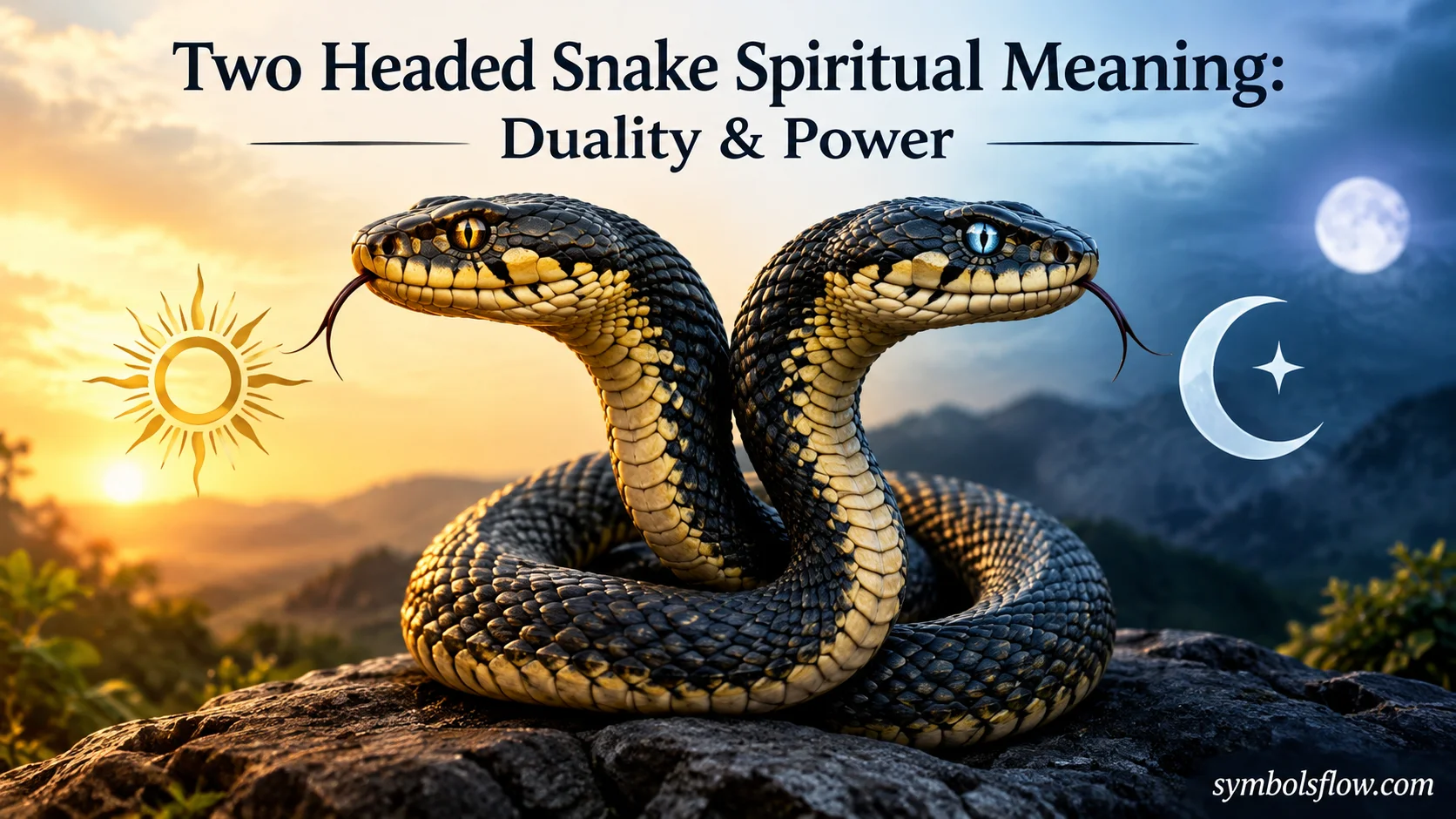
Two Headed Snake Spiritual Meaning: Duality & Power points to two heads, two sets of eyes, and two mouths within one symbolic life.
A two-headed snake can appear as a strange image in a normal snake dream, where the subconscious uses an unusual creature to express conflict, tension, or an impossible choice. Its two directions can suggest opposing forces, two powers, balance, choice, and combined power while one body holds one life. The double headed snake remains a highly misunderstood symbol because its meaning is not fixed. Its connection with ancient mythology, the Amphisbaena of Greek legend, biblical imagery, the New Testament, and the Hebrew Bible gives the two-headed serpent a wide symbolic history.
Snakes can represent evil, death, poison, deceit, and temptation, yet they also represent fertility, faith, healing, wisdom, mystery, and hidden knowledge. The symbolism predates Christian and Hebrew texts, with hieroglyphs and images in Egypt and Mesoamerica, including associations with the Aztec god Quetzalcoatl and 1519. A snake that can shed its skin and emerge anew naturally connects with renewal, rebirth, transformation, and energy, making the serpent an enigmatic symbol of complete transformation.
“Let’s dive in!
Quick Answer
Two Headed Snake Spiritual Meaning commonly symbolizes duality, transformation, opposing forces, and shared power in American spiritual and symbolic settings. More broadly, two-headed serpents can represent creation and destruction, life and death, wisdom and danger, or two paths existing within one life.
TL;DR
- Two-headed snakes commonly represent duality and opposing forces.
- Snakes traditionally symbolize transformation because they shed their skin.
- Ancient cultures used serpents in healing, fertility, protection, and mythology.
- In America, the image often appears in tattoos and fantasy art.
- Spiritual interpretations vary widely between cultures and individuals.
- The symbol can represent conflict, balance, choice, or personal transformation.
What Does a Two-Headed Snake Symbolize?
A two-headed snake combines familiar serpent symbolism with the idea of two distinct forces. Because both heads share one body, the image naturally suggests connection as well as tension.
For American readers, this can make the symbol useful when thinking about complicated experiences. A person may feel pulled between two choices while still remaining one complete person.
Core Symbolic Meanings
- Duality between two different forces or identities
- Transformation through periods of inner conflict
- Power created through two connected energies
- Wisdom gained by seeing opposing perspectives
- Protection through awareness of multiple directions
- Choice between different paths or possibilities
The meaning doesn’t have to be negative. A two-headed snake can show that apparently opposite qualities can coexist.
For example, courage and caution may seem different, yet both can help someone make a thoughtful decision.
Ancient Roots of Two-Headed Serpents
Snake imagery is extremely old, appearing in myths, religious art, pottery, jewelry, and ceremonial objects. However, a specific two-headed snake doesn’t have one universal origin or meaning.
Instead, two-headed serpent imagery appears in different cultural settings. Each tradition needs to be understood within its own historical context rather than treated as evidence of one shared belief.
Serpents in Ancient Symbolism
Across ancient societies, snakes were associated with powerful natural processes. Their ability to shed skin made them especially suitable symbols of renewal and change.
Some traditions also connected serpents with the earth, water, fertility, healing, or hidden knowledge. Their movement between visible and hidden spaces added to their mysterious reputation.
Why Two Heads Matter
Adding a second head changes the basic serpent image. Instead of one direction, there are now two.
This can suggest:
- Two forces sharing one existence
- Opposing choices within one situation
- Increased awareness of surrounding danger
- Conflict between competing desires
- Cooperation between different powers
These meanings are interpretations, not universal ancient rules. Historical symbols often had several meanings at once.
Snake Symbolism in Ancient and Religious Traditions
Snake symbolism developed differently across civilizations. Some traditions treated serpents as protective or healing figures, while others connected them with danger, temptation, chaos, or hidden forces.
This contrast remains important today. A modern reader shouldn’t assume that every snake symbol represents evil or every serpent represents wisdom.
Serpents and Renewal
The shedding of snake skin provides an obvious image of renewal. As a result, snakes have often been linked with cycles of change and regeneration.
The two-headed version can extend this idea. It may suggest transformation happening in more than one area of life.
Serpents and Healing
The serpent has also appeared in historical healing symbolism. The connection is especially visible in classical traditions involving medical imagery.
However, the two-headed snake itself shouldn’t automatically be treated as a medical symbol. Its meaning depends on the specific artwork, tradition, and setting.
Two-Headed Snake Spiritual Meaning in America
In the United States, the symbol often appears outside formal religious traditions. Instead, people may encounter it through mythology, fantasy, tattoos, artwork, jewelry, and personal spirituality.
American interpretations also tend to blend older symbolism with modern ideas about identity and personal growth.
Modern American Associations
| Context | Meaning in the USA | Common Associations | Notes |
| Tattoo | Dual identity or transformation | Strength, change, individuality | Meaning depends on personal design |
| Spiritual art | Inner conflict or balance | Energy, renewal, awareness | Often highly personal |
| Fantasy imagery | Power or supernatural ability | Mystery, danger, magic | Usually fictional rather than religious |
| Jewelry | Protection or individuality | Symbolic identity, uniqueness | Cultural meaning varies |
| Myth-inspired art | Ancient power and mystery | Legends, cycles, hidden knowledge | Historical accuracy may vary |
American popular culture often turns unusual symbols into personal statements. Therefore, someone wearing a two-headed snake may be expressing individuality rather than following a specific spiritual tradition.
What Does a Two-Headed Snake Mean Spiritually?
Spiritually, a two-headed snake can represent two energies operating within one life. This can be interpreted as a reminder to recognize conflicting feelings rather than ignoring them.
Balance Between Opposites
The two heads may represent opposing qualities such as:
- Light and darkness
- Wisdom and instinct
- Protection and danger
- Creation and destruction
- Past and future
- Independence and connection
The important idea is coexistence. One body connects both heads, suggesting that opposing experiences can still belong to the same personal journey.
Transformation and Growth
Snakes already carry strong transformation symbolism because they shed their old skin. Two heads can make that transformation more complex.
Someone might therefore view the image as a reminder that growth can involve conflicting emotions. Change doesn’t always feel simple or peaceful.
Two-Headed Snake Meaning in Dreams
Dream symbolism is highly personal, so a two-headed snake dream doesn’t have one fixed interpretation. Your feelings during the dream may matter as much as the animal itself.
If the Snake Feels Threatening
A threatening two-headed snake might reflect a sense of being pulled in different directions. It could also represent uncertainty about competing choices.
However, dreams don’t provide reliable predictions about future events. Personal memories, stress, emotions, and recent experiences can all influence dream imagery.
If the Snake Feels Calm
A peaceful snake may suggest a different emotional association. You might connect the image with acceptance, awareness, or the ability to hold two ideas together.
The surrounding dream details can provide more useful context than the snake alone.
Psychological Meaning of a Two-Headed Snake
Psychologically, the image can work as a powerful metaphor for inner complexity. One body with two heads creates an immediate picture of competing impulses.
For example, someone may want change while also fearing it. The symbol can represent that tension without requiring one side to be labeled good and the other bad.
A Symbol of Inner Conflict
A two-headed snake can metaphorically express:
- Conflicting goals
- Mixed emotions
- Difficult decisions
- Divided attention
- Competing identities
- Unresolved personal tension
At the same time, the image can symbolize integration. Two different perspectives don’t necessarily mean that someone is broken or divided.
Read More: Keep Your Hand on the Plow Spiritual Meaning: Faith
Two-Headed Snake Meaning in Tattoos
Two-headed snake tattoos are visually distinctive and can carry several personal meanings. In American tattoo culture, the design may be chosen because of its unusual shape as much as its symbolism.
Common Tattoo Themes
A person might use the design to represent transformation, resilience, personal duality, or overcoming a difficult period.
Design details can also influence interpretation. For instance, open mouths may emphasize conflict, while symmetrical heads may emphasize balance.
Colors and Design Choices
Black ink can create a traditional or mysterious appearance. Green, red, gold, or blue can shift the visual mood without creating a universal symbolic rule.
A tattoo combining a snake with flowers, moons, skulls, or geometric patterns may also introduce additional meanings.
Two-Headed Snake in Mythology and Popular Culture
Two-headed creatures are common in mythology, folklore, fantasy, and modern entertainment. They often represent extraordinary power because they break ordinary expectations of nature.
Why the Image Feels Powerful
The human mind naturally notices unusual symmetry and unexpected combinations. One snake with two heads therefore creates immediate visual tension.
Popular culture can amplify that effect. Fantasy stories may use two-headed serpents as guardians, monsters, magical creatures, or symbols of supernatural power.
However, fictional portrayals shouldn’t automatically be treated as evidence of ancient spiritual beliefs.
Cross-Cultural Meanings of Serpent Symbolism
Serpents have appeared in many cultural traditions, but their meanings differ considerably. Some emphasize renewal or healing, while others focus on danger, temptation, fertility, or cosmic forces.
A Respectful Comparison
In some ancient American cultures, serpent imagery held major religious and political significance. In South Asian traditions, serpents can appear within complex spiritual and mythological systems. In classical Mediterranean traditions, serpents could connect with healing, protection, or divine imagery.
These traditions are not interchangeable. A modern two-headed snake image may borrow visual ideas without carrying the original cultural meaning.
Avoiding a Common Mistake
It’s tempting to say that snakes universally mean “rebirth” or “evil.” History doesn’t support such a simple rule.
Instead, serpent symbolism should be read through its culture, period, artwork, and surrounding symbols.
Is a Two-Headed Snake a Symbol of Good or Evil?
A two-headed snake isn’t inherently a symbol of either good or evil. Its interpretation depends on the tradition and context in which it appears.
Positive Interpretations
A positive reading may emphasize awareness, transformation, protection, wisdom, or balance.
Negative Interpretations
A darker interpretation may focus on danger, deception, conflict, unpredictability, or competing forces.
Both interpretations can exist without one being universally correct. Symbolism is shaped by cultural history and personal experience.
Misunderstandings and Misuse of the Symbol
Because snake imagery has many meanings, it’s easy to make broad claims about what a two-headed serpent “always” represents.
For example, calling every two-headed snake image demonic ignores the wide range of serpent symbolism found throughout history.
Common Misunderstandings
- Assuming every snake symbol represents evil
- Treating modern fantasy imagery as ancient religious evidence
- Assigning one meaning to every culture
- Confusing personal spirituality with historical tradition
- Assuming unusual anatomy automatically signals danger
Modern creators also sometimes combine symbols from unrelated traditions. That can produce visually compelling art, but it may not accurately represent the original cultures involved.
How the Meaning Has Changed Over Time
Snake symbolism has never stayed completely fixed. Meanings have shifted as religious beliefs, artistic styles, psychology, entertainment, and social trends changed.
Ancient serpent imagery often reflected nature, fertility, healing, protection, or cosmic ideas. Later traditions sometimes emphasized moral danger or temptation, while modern popular culture frequently uses snakes for transformation and mystery.
From Ancient Symbol to Personal Symbol
Today, Americans may use a two-headed snake without identifying with any historical tradition. A tattoo, artwork, or necklace can simply express personal growth or individuality.
This is one of the biggest shifts in modern symbolism. Symbols once tied to specific cultural settings can now become flexible tools for personal expression.
Two-Headed Snake Meaning in Modern Spirituality
Modern spirituality often combines historical symbolism with personal reflection. In this setting, the two-headed snake may become a metaphor for navigating change and conflicting parts of life.
A Symbol for Personal Reflection
Someone might use the image when thinking about:
- A major life transition
- A difficult personal decision
- Conflicting values
- Emotional growth
- Accepting different sides of oneself
- Finding balance during uncertainty
This approach doesn’t require believing that the symbol predicts events. It can simply provide a visual language for reflection.
What Does Seeing a Two-Headed Snake Mean?
Seeing an actual two-headed snake would be an unusual biological occurrence rather than automatic proof of a spiritual message. Two-headed animals can result from developmental abnormalities known as bicephaly.
If someone encounters such an animal, the event may still feel personally meaningful. However, the scientific explanation and a person’s symbolic interpretation are separate questions.
Symbolic Reflection
If the image stays in your mind, you might ask what “two directions, one body” means in your current situation.
That question can be useful without assuming that the encounter carries a predetermined supernatural message.
FAQs:
1. What does a two-headed snake mean spiritually?
A two-headed snake often symbolizes duality, balance, opposing forces, and two different powers existing within one life. It may represent an important choice or inner conflict.
2. Is seeing a two-headed snake a good or bad spiritual sign?
It does not have one fixed meaning. It can symbolize protection, transformation, healing, and renewal, but it may also represent danger, conflict, temptation, or uncertainty. Personal context matters.
3. What does a two-headed snake mean in a dream?
A two-headed snake dream may reflect competing thoughts, emotions, relationships, or decisions. The meaning can depend on how the snake behaved and how you felt during the dream.
4. What does a two-headed snake symbolize in different cultures?
Snakes have appeared in many cultural traditions as symbols of healing, fertility, wisdom, danger, transformation, and mystery. Two heads can add themes of duality, shared power, conflict, and balance.
5. Does a two-headed snake represent transformation?
Yes. Because snakes shed their skin, they are commonly associated with renewal, rebirth, and transformation. Two heads can suggest that this change involves competing directions or two parts of life developing together.
Conclusion:
The Two Headed Snake Spiritual Meaning: Duality & Power centers on the idea of two forces sharing one life. Its unusual form can represent balance, conflict, protection, transformation, choice, and combined power. Across mythology, spiritual traditions, dreams, and modern symbolism, the image carries different meanings rather than one universal message. Understanding the surrounding context, personal beliefs, emotions, and circumstances can make the symbolism more meaningful. A two-headed snake can therefore serve as a powerful reminder to recognize opposing forces, accept transformation, and find balance between different parts of life.

1 thought on “Two Headed Snake Spiritual Meaning: Duality & Power”