
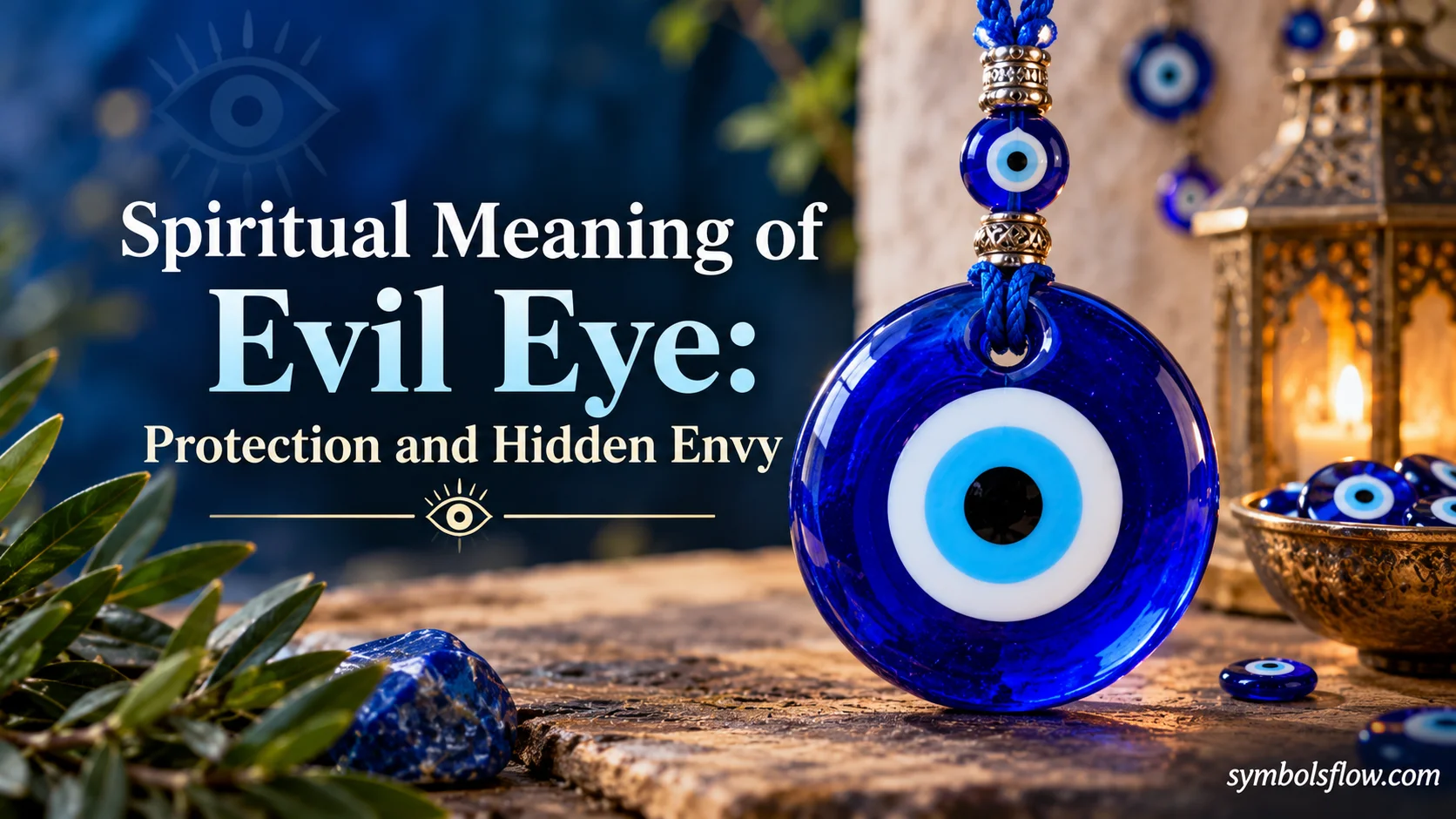
The spiritual meaning of evil eye has fascinated people for thousands of years. Across many cultures, this symbol represents protection against jealousy, harmful intentions, and unwanted attention. Today, people in the United States wear evil eye jewelry, display blue charms in their homes, and explore its meaning as part of their spiritual journeys.
However, the evil eye has two related meanings. First, it describes a traditional belief that an envious or harmful gaze can bring misfortune. Second, it refers to the protective symbol people use to guard against that perceived danger. Understanding this difference makes the symbol easier to appreciate.
The evil eye is especially recognizable as a blue circle with white and dark blue rings surrounding a central pupil. Although this design is popular, the symbol appears in many colors, materials, and forms. Its meaning also changes depending on family traditions, religious beliefs, and personal experiences.Whether you discovered the symbol on a bracelet, necklace, tattoo, or decorative object, its deeper message connects to protection, emotional boundaries, and the complicated relationship between envy and admiration.
“Let’s dive in!
Quick Answer
The spiritual meaning of evil eye centers on protection, awareness, and guarding against envy or harmful intentions. In the United States, people often wear it as a protective charm, while other cultures connect it with ancient traditions, spiritual beliefs, and the desire to preserve good fortune.
TL;DR
- The evil eye traditionally represents protection against envy and harmful attention.
- Its history reaches back thousands of years across ancient civilizations.
- Blue and white amulets are especially recognizable in modern American culture.
- Different religions and cultures interpret the symbol in distinct ways.
- Jewelry, tattoos, and home decor keep the symbol visible today.
- Its spiritual meaning depends on personal beliefs and cultural background.
1. What Is the Evil Eye Symbol?
The evil eye is a traditional symbol connected to the belief that a harmful gaze can bring misfortune. At the same time, the eye-shaped amulet commonly sold today is intended to protect against that perceived danger. This distinction is important when exploring its spiritual meaning.
Appearance and Common Designs
The familiar evil eye charm usually contains several circles arranged around a central pupil. Blue and white are common colors, although green, black, red, and gold versions also appear.
The symbol can be made from glass, ceramic, metal, beads, fabric, or precious stones. Some designs feature a simple eye, while others incorporate hands, flowers, or decorative patterns.
What the Symbol Represents
People commonly associate the evil eye with three ideas:
- Protection: Guarding against jealousy, ill will, or unwanted attention.
- Awareness: Recognizing how envy and comparison can affect relationships.
- Good fortune: Preserving peace, happiness, and personal well-being.
However, these meanings aren’t universal. Some people regard the charm as spiritually powerful, while others appreciate it mainly for its cultural history or appearance.
2. Ancient Origins of the Evil Eye
The belief behind the evil eye is much older than modern jewelry and decorative charms. Its history reaches into ancient societies where people connected the gaze with powerful emotions, spiritual forces, and unexpected misfortune.
Early Mesopotamian Traditions
Written references associated with the evil eye can be traced to ancient Mesopotamia, including traditions from the third millennium BCE. People in this region developed protective practices to address dangers they believed could arise from envy or hostile spiritual forces.
Over time, protective objects became part of everyday life. Eye-shaped designs and other amulets offered a visible way to seek protection for people, homes, animals, and valued possessions.
Ancient Greece and Rome
The belief also appeared in ancient Greek and Roman societies. Writers discussed the potentially harmful power of envy, admiration, and the gaze.
For example, a person’s beauty, success, or prosperity could attract unwanted attention. Therefore, protective customs developed around children, celebrations, and valuable possessions.
These ancient practices didn’t follow one universal system. Instead, each society developed its own explanations, rituals, and protective objects.
How the Tradition Evolved
As people traveled, traded, and settled in new regions, symbols and customs moved between communities. However, similarities don’t always prove that every tradition came from one original source.
The evil eye continued through changing religious, cultural, and artistic traditions. Today, it remains recognizable because its central concerns—envy, vulnerability, and protection—are still familiar to many people.
3. Spiritual Meaning of Evil Eye in the USA
In the United States, the evil eye has become a familiar feature of jewelry, fashion, home accessories, and spiritual conversations. Its meaning reflects both immigrant traditions and a wider interest in symbols of protection.
Protection in Everyday American Life
Many Americans encounter the evil eye through bracelets, necklaces, keychains, and small glass ornaments. Some wear it as a personal protective charm, while others display it as a reminder to remain grounded.
For people with family connections to Mediterranean, Middle Eastern, Jewish, Muslim, or South Asian communities, the symbol may carry generations of cultural meaning.
For other Americans, it represents a general desire to protect their peace and avoid negative influences. These interpretations can coexist, although they aren’t identical.
A Symbol of Personal Boundaries
Modern American culture often connects spiritual well-being with boundaries, self-respect, and emotional balance. Within this context, the evil eye may serve as a reminder to protect one’s privacy and avoid unhealthy comparisons.
For example, someone might wear the symbol while starting a new job or entering a new stage of life. The charm can represent hope and confidence without requiring the wearer to believe that every difficulty comes from another person’s envy.
Everyday Meanings in American Culture
| Context | Common Meaning | Modern Association |
| Jewelry | Protection and awareness | Personal expression |
| Home decor | Peace and safeguarding | Welcoming surroundings |
| Gifts | Care and good wishes | Support during change |
| Tattoos | Resilience and boundaries | Lasting personal symbolism |
| Social media | Spiritual identity | Sharing cultural interests |
The table illustrates common interpretations rather than fixed rules. A symbol’s meaning ultimately depends on the person using it and the traditions they follow.
4. The Meaning of Blue, White, and Other Evil Eye Colors
Color plays an important role in the modern appearance of evil eye charms. Although blue and white are especially popular, different colors can carry additional meanings based on local customs and personal interpretations.
Blue Evil Eye
Blue is the color most commonly associated with the familiar protective amulet. In modern spiritual interpretations, it often represents calmness, protection, trust, and peace.
Some traditions also connect blue charms with protection from envy or unwanted attention. However, there’s no single color system shared by every culture.
White Evil Eye
White often symbolizes purity, clarity, innocence, and fresh beginnings. A white evil eye may appeal to someone seeking a peaceful reminder of personal intentions.
When combined with blue, white also helps create the recognizable appearance of the traditional glass amulet.
Green, Red, and Black Designs
Other colors can add personal or contemporary meanings to the symbol.
- Green: Often associated with growth, renewal, and hope.
- Red: May represent courage, vitality, and strength.
- Black: Can suggest resilience, grounding, or protection.
- Gold: Often expresses prosperity, confidence, or abundance.
These are common modern associations, not universal traditional definitions. Before interpreting a particular charm, consider its cultural origin and the intention behind its design.
Read More: Spiritual Meaning of Glass in Foot: Hidden Messages
5. Evil Eye Meaning Across Different Cultures and Religions
The evil eye appears in many cultural and religious settings, but its interpretation differs from one community to another. Understanding these differences helps readers appreciate the symbol without treating diverse traditions as interchangeable.
Mediterranean and Middle Eastern Traditions
In Turkey and parts of the surrounding region, the blue glass charm is commonly known as the nazar boncuğu. It is used as a protective amulet and also appears in jewelry, household decorations, and gifts.
Across parts of the Middle East and North Africa, protective objects may be placed near homes, children, or valued possessions. The details vary between families and communities.
Jewish and Muslim Traditions
In some Jewish communities, the evil eye is known as ayin hara, a term associated with the harmful power of envy. Protective customs vary, and not every Jewish person follows the same practices.
In Muslim communities, belief in the evil eye exists in several traditions. Some people seek protection through prayer and religious recitation, while others also use culturally familiar charms.
However, religious views about amulets differ. A decorative eye charm should not automatically be treated as an accepted religious practice for every believer.
South Asian and Latin American Traditions
In South Asian communities, the evil eye is often called nazar and may be connected to envy, admiration, or unwanted attention. Families use different customs to protect children, relationships, and important occasions.
In many Latin American communities, the related concept of mal de ojo describes a harmful gaze. Protective practices may include bracelets, prayers, or other family traditions.
Although these beliefs share similarities, their histories and practices are not identical. Each deserves to be understood within its own cultural setting.
6. Psychological and Emotional Meaning of the Evil Eye
Beyond supernatural beliefs, the evil eye can represent familiar human emotions. Envy, insecurity, fear of judgment, and the desire for safety all influence how people understand the symbol.
Envy and Social Comparison
People sometimes feel uncomfortable when their success attracts attention. Others may worry that sharing good news could invite criticism or jealousy.
In this context, the evil eye becomes a symbol of awareness around social comparison. It can remind people to celebrate their achievements without measuring their worth against someone else’s reaction.
Safety and Emotional Boundaries
A protective charm can also provide emotional reassurance. Wearing one may help a person feel connected to family, culture, or a meaningful spiritual practice.
However, the charm doesn’t establish that another person has harmful intentions. Instead, its personal value may come from the comfort and meaning the wearer associates with it.
Reflection Without Fear
A balanced interpretation focuses on self-awareness rather than suspicion. People can maintain healthy boundaries without assuming that every setback comes from jealousy.
Consider the symbol a reminder to protect your peace, value supportive relationships, and respond thoughtfully to difficult situations.
7. Spiritual Meaning of Evil Eye Jewelry and Tattoos
Modern evil eye designs appear in necklaces, rings, bracelets, earrings, and body art. Their popularity reflects a mixture of cultural tradition, personal expression, and contemporary interest in spirituality.
Wearing an Evil Eye Bracelet
Some people wear an evil eye bracelet as a protective charm, while others choose one because of its color and design.
It may also serve as a meaningful gift for someone beginning a new chapter. For example, a friend might give a bracelet to someone moving away, starting school, or celebrating an important milestone.
The gift can express care and good wishes without implying that danger is certain.
Evil Eye Tattoos
An evil eye tattoo may represent resilience, cultural identity, spiritual protection, or awareness of envy. Some people choose a small, simple eye, while others combine it with flowers, moons, hands, or geometric designs.
Placement can also affect personal meaning. A tattoo on the wrist might serve as a frequent reminder, while a hidden design may represent a private belief.
Because the symbol has deep cultural associations, learning about its background before choosing a permanent design is worthwhile.
Jewelry as a Personal Statement
In American fashion, evil eye designs can be worn with casual clothing, formal outfits, or other symbolic accessories. Some wearers see them as spiritual objects, while others appreciate their distinctive appearance.
Neither interpretation should automatically be assumed from someone’s clothing. The wearer is best placed to explain what the symbol means to them.
8. Evil Eye Symbolism in Homes and Everyday Spaces
The evil eye is also used in home decor, where it may represent protection, hospitality, or a connection to family traditions. Its placement can be meaningful even when the object serves a decorative purpose.
Near the Entrance
Some families place an evil eye charm near a doorway or entrance. Within these traditions, it may symbolize protection for the household and the people entering it.
In a modern home, a blue glass charm can also become a conversation piece or a reminder of family heritage.
In Bedrooms and Living Spaces
An evil eye ornament might appear on a shelf, wall hanging, mirror, or bedside table. People sometimes choose these locations because they want the symbol to remain visible during daily routines.
Its significance may be spiritual, sentimental, or simply artistic. There isn’t one universally required place to display it.
As a Gift for a New Home
An evil eye charm may be given during a move, housewarming, or other major life change. In this context, it can express wishes for peace, happiness, and security.
However, a gift doesn’t have to carry the same meaning for everyone. A short explanation of its background can make the gesture more thoughtful and respectful.
9. What Does the Evil Eye Mean in Dreams?
Dream interpretations vary, and no single meaning can be established for every dream involving an eye or protective charm. Still, the image can offer a useful starting point for personal reflection.
Seeing an Evil Eye Charm
Dreaming of an evil eye charm might reflect a desire for safety, reassurance, or greater control during a stressful period.
If the charm felt comforting in the dream, consider whether you’re seeking stability or support in everyday life.
Someone Giving You the Evil Eye
A dream involving a threatening gaze might reflect concerns about judgment, conflict, or being misunderstood. However, it doesn’t prove that someone is jealous of you or wishes you harm.
Instead, think about your recent experiences and the emotions you felt during the dream.
A Broken or Lost Evil Eye
A broken charm in a dream may bring up feelings of vulnerability or uncertainty. Alternatively, it might simply reflect a recent memory or something you’ve seen.
Rather than treating the dream as a warning, use it as an opportunity to consider what has been occupying your thoughts.
10. Misunderstandings and Controversies About the Evil Eye
The evil eye is widely recognized, but its popularity can lead to confusion. Understanding the difference between cultural tradition, personal belief, and commercial fashion helps prevent common misunderstandings.
Is the Evil Eye a Symbol of Evil?
Not necessarily. Although the name sounds threatening, the familiar eye-shaped amulet is generally intended to protect against the evil eye, not to promote harm.
The harmful gaze and the protective charm are related but distinct ideas.
Does Wearing It Guarantee Protection?
There is no reliable scientific evidence that an evil eye charm can prevent supernatural harm or control another person’s intentions. Its importance comes from cultural traditions, personal beliefs, and symbolic meaning.
For believers, the charm may form part of a broader spiritual practice. Others may value it as a reminder of their heritage or personal boundaries.
Is the Symbol Appropriate for Everyone to Wear?
People encounter cultural symbols through travel, friendships, fashion, and family connections. Wearing an evil eye design isn’t automatically disrespectful, but understanding its history matters.
Concerns may arise when a meaningful cultural or religious symbol is marketed without context or presented as a universal spiritual solution.
A thoughtful approach includes learning where the symbol comes from, respecting its living traditions, and avoiding assumptions about the beliefs of those who wear it.
11. How the Evil Eye’s Meaning Has Changed Over Time
The evil eye has remained recognizable while its uses have changed. What once served primarily as a traditional protective object can now function as jewelry, decoration, a cultural marker, or a fashion statement.
From Traditional Amulet to Modern Accessory
Historically, protective objects were used in many societies to address fears about envy, misfortune, and spiritual danger. Their materials and designs reflected the resources and beliefs of their communities.
Over time, travel, migration, trade, and cultural exchange helped familiar eye-shaped charms reach wider audiences.
Cultural Heritage and Global Fashion
Today, the evil eye appears in international markets and mainstream fashion. For some people, it remains a deeply meaningful symbol passed through generations.
For others, it is a decorative motif discovered through social media or retail stores. Both uses exist, although they may reflect different levels of cultural knowledge.
What Has Stayed the Same?
Despite these changes, protection remains one of the symbol’s strongest associations. Its connection to envy also continues to resonate because people still navigate admiration, competition, and social judgment.
The modern evil eye therefore combines an ancient cultural history with contemporary questions about privacy, belonging, and personal identity.
12. How to Understand the Evil Eye’s Meaning in Your Own Life
You don’t need to follow a particular spiritual tradition to explore why the evil eye interests you. A thoughtful interpretation begins with the symbol’s history and your own reasons for noticing it.
Consider Your Personal Intention
If you wear or display an evil eye charm, ask yourself what it represents. Your answer might involve protection, family heritage, emotional boundaries, or appreciation for its design.
Understanding your intention can make the symbol more meaningful than simply following a trend.
Respect Cultural Differences
Because the evil eye appears in many traditions, avoid assuming that every charm has the same religious or spiritual meaning.
If someone shares the symbol as part of their heritage, listen to their explanation rather than relying on a single generalized interpretation.
Keep the Meaning Grounded
A protective symbol can encourage reflection and reassurance without becoming a source of fear. You can appreciate its history while recognizing that ordinary difficulties have many possible causes.
Ultimately, the most helpful interpretation is one that supports understanding, respect, and a balanced outlook.
FAQs:
What does the evil eye symbolize spiritually?
The evil eye commonly symbolizes protection against envy, harmful intentions, and unwanted attention. Some people also connect it with awareness, emotional boundaries, and preserving good fortune.
Is the evil eye good luck or bad luck?
The answer depends on what someone means by the term. The harmful gaze is traditionally associated with misfortune, while the familiar eye-shaped amulet is generally intended to offer protection against it.
What does a blue evil eye mean?
A blue evil eye charm is commonly associated with protection, peace, and calmness. Its familiar blue-and-white design is especially popular in Turkish and wider Mediterranean traditions.
Can anyone wear an evil eye bracelet?
People from different backgrounds wear evil eye bracelets for cultural, personal, decorative, or spiritual reasons. Learning about the symbol’s origins and respecting the traditions connected to it can help you wear it thoughtfully.
What does it mean when an evil eye charm breaks?
Some traditional interpretations treat a broken charm as a sign that it has absorbed or deflected harmful energy. However, this is a spiritual belief rather than a proven fact, and ordinary wear or accidental damage is also possible.
Conclusion:
The spiritual meaning of evil eye brings together protection, awareness, cultural heritage, and the long-standing human concern about envy. From ancient protective traditions to modern American jewelry and home decor, the symbol has adapted while retaining its recognizable connection to safeguarding what matters.
Its meaning isn’t exactly the same for everyone. Some people regard the evil eye as a spiritual charm, while others appreciate it as a reminder of family, identity, or emotional boundaries.Ultimately, you can explore this ancient symbol with curiosity rather than fear. Learn about its cultural roots, consider what it represents to you, and let its deeper message encourage respect, reflection, and peace in everyday life.

1 thought on “Spiritual Meaning of Evil Eye: Protection and Hidden Envy”