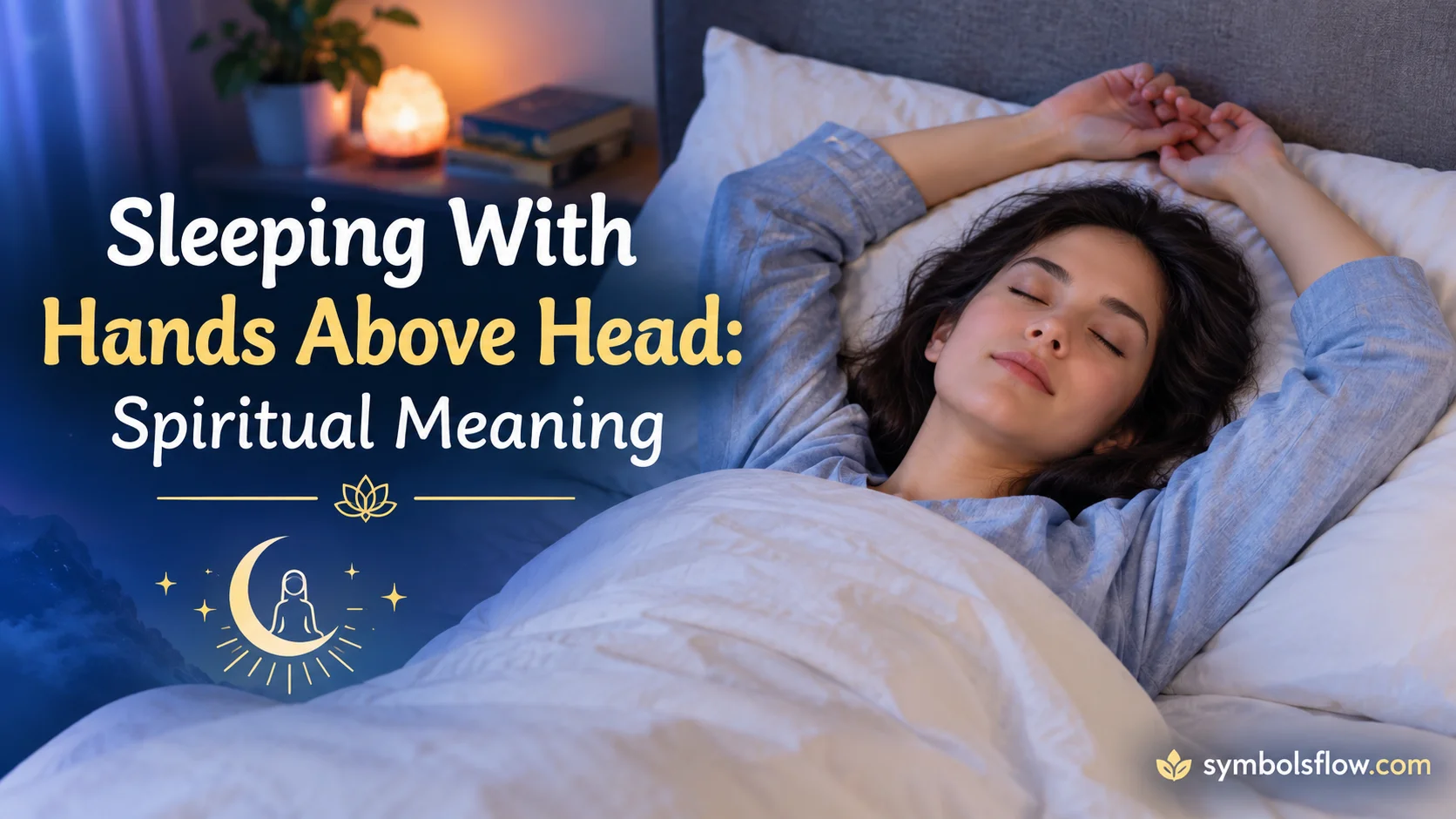
Sleeping With Hands Above Head: Spiritual Meaning can connect a sleeping position with personal growth, inner peace, and deeper spiritual meaning in everyday life.
A sleep habit may begin early in life, and people generally stick with it. A side sleeper at seven may remain a side sleeper now, while a dedicated mattress hogger may claim the whole bed for themselves. From the foetal position to the full starfish sprawl, your go-to sleeping position may say about you while showing what feels natural for your body and whether it is doing your body any favours.
When you wake up and realize your arms are stretched above your head, you may have slept this way for hours. Sleeping with hands above your head can feel comfortable, and this position may carry a spiritual meaning through body symbolism. The posture can be viewed as a sign of openness, higher energy, and a connection with the universe. Spiritually, it can represent surrender, trust, and personal growth. Relaxed hands and an open body may suggest a willingness to receive instead of trying to control every experience.
“Let’s dive in!
Quick Answer
Sleeping with Hands Above Head Spiritual Meaning: Openness is commonly interpreted as openness, surrender, emotional release, and receptivity. In the USA, it can also symbolize comfort and freedom, while broader spiritual interpretations sometimes connect raised hands with trust or reaching toward something greater.
TL;DR
• Hands above the head can symbolize openness and emotional receptivity.
• Raised arms often represent surrender, release, freedom, or trust.
• There’s no universal spiritual meaning for this sleeping posture.
• Physical comfort can explain the position without deeper symbolism.
• Spiritual interpretations vary across cultures and personal beliefs.
• Modern readers often use the posture for self-reflection.
What Does Sleeping With Hands Above Your Head Mean?
The meaning depends heavily on context, personal beliefs, and how the posture feels. Someone may simply find this position comfortable, while another person may view it as a symbol of emotional or spiritual openness.
The Basic Symbolic Idea
When your arms rest above your head, your body appears expanded rather than closed. Symbolically, that can suggest a willingness to receive, relax, or let go.
Open body positions are often associated with confidence and reduced defensiveness. Therefore, spiritual interpretations naturally connect this posture with trust and vulnerability.
Common Symbolic Meanings
People commonly associate the posture with:
• Openness to new experiences or ideas
• Surrendering worries that can’t be controlled
• Emotional release after a stressful period
• A desire for freedom and personal space
• Receptivity toward spiritual reflection or guidance
• Inner relaxation and a sense of safety
These meanings should be viewed as reflective symbols, not fixed rules.
Why Do People Sleep With Their Hands Above Their Head?
There are many ordinary reasons someone may naturally move their hands overhead. Sleep involves constant movement, and people often change positions without remembering it.
Comfort Comes First
Some people simply prefer having their shoulders and arms in an extended position. Stretching the arms can also feel comfortable after spending the day sitting, working, or using electronic devices.
Because of this, a spiritual interpretation shouldn’t automatically replace a simple physical explanation.
The Role of Habit
Sleeping posture can become a familiar pattern. If the position feels comfortable, the body may return to it repeatedly without conscious thought.
Therefore, noticing the habit doesn’t necessarily mean something unusual is happening. The symbolism becomes more useful when you treat it as a prompt for personal reflection.
Spiritual Symbolism of Raised Hands
Raised hands have carried symbolic meaning in many spiritual and religious settings. However, those traditions generally involve deliberate gestures rather than unconscious sleeping positions.
Reaching Upward
Across religious art and spiritual practices, raised arms can suggest reaching toward the heavens. The gesture may represent prayer, praise, hope, surrender, or seeking help.
That visual tradition helps explain why modern spiritual writers sometimes interpret sleeping arms as a sign of receptivity.
Openness and Surrender
Open arms can also suggest that a person isn’t protecting themselves from everything around them. Symbolically, this creates an association with trust.
However, sleeping with raised hands doesn’t prove that someone feels spiritually surrendered. It simply provides an interesting image for exploring that idea.
Historical Roots of Raised-Arm Symbolism
The symbolism of raised arms is much older than modern sleep-position discussions. Ancient societies used body gestures to communicate ideas that words could not always express.
Ancient and Pre-Christian Connections
In ancient Mediterranean and Near Eastern cultures, gestures toward the sky could appear in religious art, ritual, and prayer. The upward direction naturally connected human action with gods, heavens, sunlight, or divine power.
Ancient Egyptian art, for example, frequently used carefully designed gestures to express relationships between humans and the divine. Yet this should not be confused with evidence that ancient Egyptians assigned a specific spiritual meaning to sleeping with hands above the head.
Religious Evolution
Later religious traditions continued using raised arms in prayer and worship. In Christianity, Judaism, Islam, Hindu traditions, and other spiritual settings, raised hands can have different meanings and practices.
The shared visual theme is more important than claiming one universal interpretation. Across history, upward gestures have often suggested connection, appeal, praise, hope, or surrender.
What Does This Sleeping Position Symbolize in America?
American interpretations are shaped by a mixture of religious traditions, psychology, wellness culture, and popular spirituality.
The American Meaning of Openness
In the United States, open body language is often associated with confidence, friendliness, and accessibility. A person lying with their arms extended can therefore appear relaxed and unguarded.
This cultural association supports the modern symbolic idea of openness. Still, the meaning remains personal rather than nationally fixed.
Freedom and Personal Space
Americans also commonly connect open physical space with independence and freedom. Arms extended overhead can visually resemble a person claiming space without appearing aggressive.
For someone going through a major life change, the posture might therefore feel like a symbol of freedom or a fresh start.
| Context | Meaning in the USA | Common Association | Important Note |
| Personal reflection | Openness | Emotional honesty | Symbolic, not diagnostic |
| Spiritual practice | Surrender | Trust and receptivity | Depends on belief system |
| Everyday sleep | Comfort | Relaxation | Often has no deeper meaning |
| Life transition | Freedom | Letting go | Personal interpretation |
| Dream reflection | Vulnerability | Being emotionally exposed | Dream meanings vary |
Emotional and Psychological Meaning
Sleeping posture can become interesting when considered alongside your emotions. The position itself doesn’t diagnose your feelings, but it can become a useful reflection tool.
Openness and Vulnerability
Arms above the head can create an exposed appearance. Symbolically, that may represent emotional vulnerability or willingness to be seen honestly.
If you’re entering a new relationship or rebuilding trust, you might naturally connect the posture with openness.
Release and Relaxation
The position can also resemble a full-body stretch. Symbolically, that makes it a strong image for releasing tension.
You might associate it with leaving behind pressure, old expectations, or emotional burdens. In that sense, the posture can become a personal reminder to relax rather than a supernatural message.
A Simple Reflection
Ask yourself:
• What am I trying to release right now?
• Where could I become more open?
• Am I learning to trust myself?
• Do I feel free or restricted lately?
• What change am I preparing to accept?
These questions can provide more useful insight than assigning one fixed meaning.
Sleeping With Hands Above Head and Spiritual Energy
Modern spiritual communities sometimes describe the body in terms of energy movement. In those systems, raised arms may be viewed as an open pathway between the body and higher awareness.
Chakra-Based Interpretations
Some contemporary spiritual writers connect this posture with the crown chakra, which is traditionally associated with consciousness and spiritual connection in certain chakra systems.
These interpretations belong to spiritual frameworks rather than established medical science. They can be meaningful to believers without being treated as proven biological facts.
Receiving Rather Than Controlling
The hands are powerful symbols because they allow people to act, hold, create, and protect. Placing them overhead can therefore represent temporarily giving up control.
Spiritually, this may be interpreted as receiving instead of forcing an outcome. That idea can be especially meaningful during uncertain periods.
Read More: Spiritual Meaning of the Eye: Symbolism & Signs
Cross-Cultural and Religious Meanings
There isn’t one global interpretation of raised hands. Similar gestures can carry different meanings depending on the tradition and situation.
Prayer and Worship
Raised hands appear in different forms of prayer and worship around the world. They can express devotion, praise, supplication, or openness.
However, a sleeping posture should not automatically be treated as a religious ritual. The intention behind a deliberate gesture matters greatly.
Meditation and Spiritual Practice
Some contemplative traditions use specific hand and arm positions during meditation. These practices can have carefully defined meanings.
That doesn’t mean every unconscious sleep movement carries the same meaning. It’s better to appreciate the connection without claiming an exact equivalence.
One Hand Above the Head vs. Both Hands
The number of hands involved can change how people interpret the posture symbolically. These interpretations are personal rather than universally recognized.
One Hand Raised
One hand above the head can suggest partial openness or a balance between reaching outward and remaining grounded. Some people may interpret it as being curious but cautious.
Both Hands Raised
Both hands create a wider, more open posture. Symbolically, this can suggest full surrender, freedom, acceptance, or receptivity.
Neither position is inherently more spiritual. The surrounding circumstances matter more than the exact placement.
Sleeping With Arms Above Head During Major Life Changes
People often become more interested in symbolic habits during periods of transition. A familiar sleep posture may suddenly feel meaningful when life itself feels uncertain.
New Beginnings
Starting a new job, relationship, home, or personal chapter can create a desire for openness. The posture may become a comforting symbol of moving forward.
Letting Go
Likewise, ending a difficult chapter can create a strong association with release. Arms stretched overhead visually resemble setting something down or opening yourself to a new direction.
Rather than predicting the future, symbolism can help you describe what you’re already experiencing.
Modern Spiritual and Cultural Uses
Today, sleep symbolism appears widely across blogs, videos, social platforms, wellness discussions, and personal journals.
Social Media and Self-Reflection
People frequently share unusual sleep habits as personality clues or spiritual signs. Such posts can be entertaining and thought-provoking.
However, short posts often remove important context. A symbolic interpretation should remain flexible instead of becoming a definite statement about someone’s character.
Home and Personal Rituals
Some people use peaceful sleeping imagery in bedrooms, journals, meditation spaces, or personal vision boards. An open sleeping figure can represent calmness, trust, and emotional freedom.
The symbolism works particularly well because sleep already represents rest, vulnerability, and renewal.
Misunderstandings and Controversies
Spiritual interpretations become problematic when symbolic ideas are presented as proven facts. Sleeping positions are influenced by many ordinary factors, including comfort and unconscious movement.
No Universal Spiritual Code
There is no universally accepted spiritual dictionary that says hands above the head always mean one specific thing. Different traditions and individuals interpret body gestures differently.
Therefore, claims about guaranteed messages, supernatural warnings, or fixed personality traits should be treated cautiously.
Avoid Fear-Based Interpretations
Some online discussions describe unusual sleeping positions as signs of negative energy or impending danger. Such claims can create unnecessary fear.
A more balanced approach is to treat the posture as a possible reflection prompt. If it feels meaningful to you, explore the meaning without assuming it predicts an event.
How the Meaning Has Changed Over Time
The broader symbolism of raised arms has remained surprisingly consistent, but its modern use has changed.
From Ritual Gesture to Personal Symbol
Historically, raised arms often appeared in formal religious, artistic, or ceremonial contexts. Today, people are more likely to interpret body positions through personal spirituality and psychology.
This shift reflects a broader modern interest in finding meaning in everyday experiences.
From Shared Tradition to Individual Meaning
Older traditions often provided established interpretations for gestures. Modern spirituality frequently encourages people to create personal connections.
As a result, the same sleeping posture can represent surrender for one person and freedom for another.
How to Reflect on This Sleeping Position
You don’t need to choose between a completely physical explanation and a completely spiritual one. Both perspectives can coexist as long as their limits are clear.
Notice the Context
Think about when you started noticing the posture. Consider whether it appears during stressful periods, peaceful periods, or major changes.
Also notice how you feel when you wake up. Calmness, tension, relief, or emotional heaviness may provide more personal context.
Keep the Interpretation Gentle
A useful symbolic interpretation should help you understand yourself rather than frighten you. You can ask what the posture represents without assuming it contains a supernatural command.
For many people, its simplest message is openness: making room for rest, change, trust, and new possibilities.
FAQs
Is sleeping with hands above your head a spiritual sign?
Some spiritual traditions and modern writers interpret it as openness, surrender, or receptivity. However, there’s no universal rule saying the posture is a spiritual sign.
What does sleeping with arms above your head say about you?
Symbolically, it may suggest openness, relaxation, vulnerability, or a desire for freedom. In everyday life, though, it may simply be your preferred sleeping position.
Does sleeping with hands above your head mean surrender?
It can symbolize surrender because raised or open arms have long been associated with letting go and trust. The meaning depends on your personal beliefs and circumstances.
Is sleeping with hands above your head connected to higher consciousness?
Some modern spiritual systems associate raised arms with spiritual awareness or connection with higher consciousness. This is a spiritual interpretation rather than a scientifically established effect.
Does one hand above the head have a different meaning?
Some people interpret one raised hand as partial openness or cautious receptivity. There is no standard spiritual meaning that applies to everyone.
Conclusion
The Sleeping with Hands Above Head Spiritual Meaning: Openness centers on ideas such as receptivity, surrender, freedom, vulnerability, and emotional release. Raised arms have a long history as symbols of reaching, prayer, trust, and connection, although sleeping itself doesn’t make the gesture a formal spiritual practice.

1 thought on “Sleeping With Hands Above Head: Spiritual Meaning”