
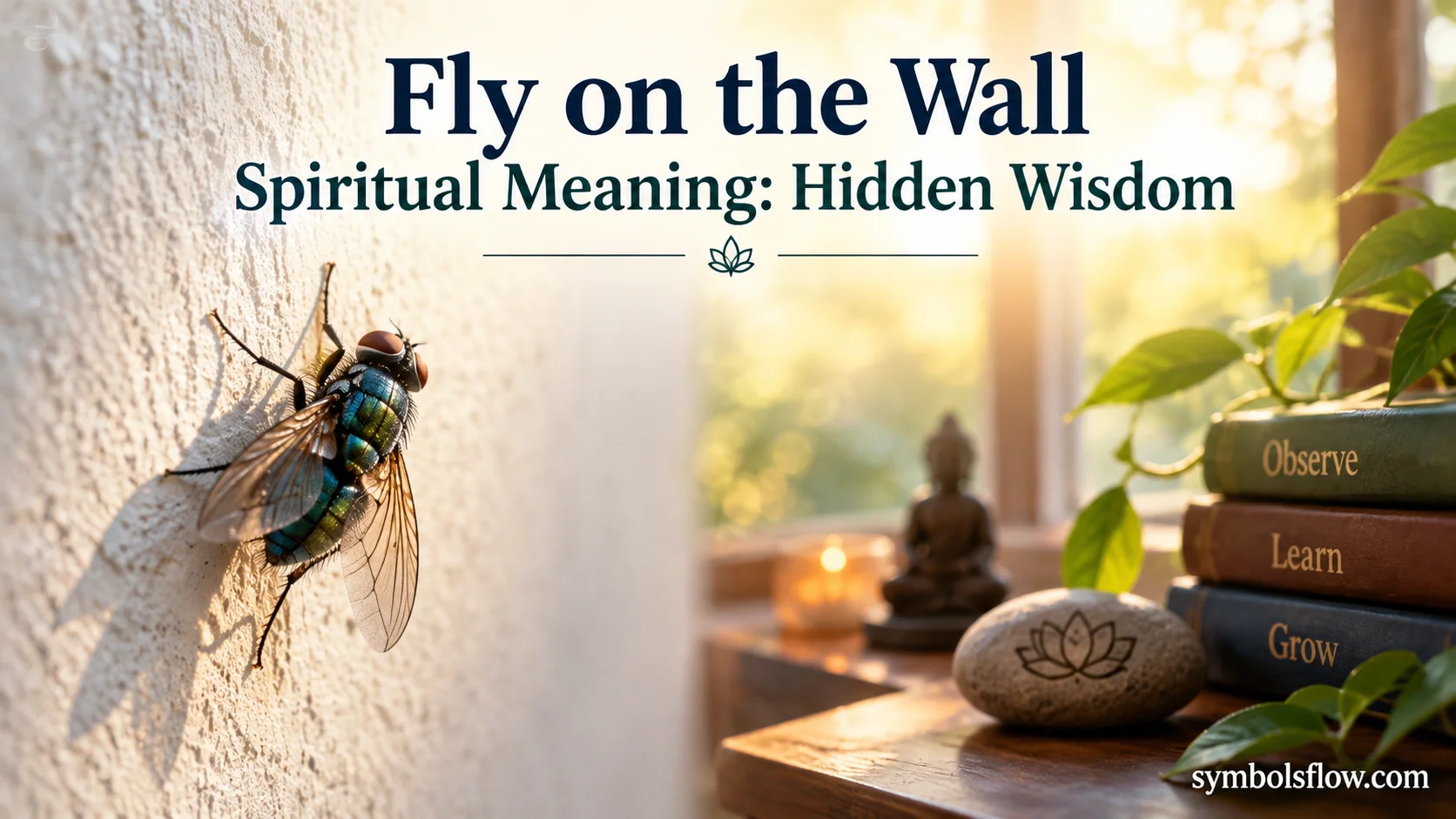
Fly on the Wall Spiritual Meaning: Hidden Wisdom reveals quiet observation, awareness, curiosity, and insight through the silent fly on a wall.
The fly on the wall spiritual meaning centers on a tiny insect sitting quietly on a wall. The fly on the wall watches without taking part. In American culture, the phrase describes an unnoticed observer who wants to see and hear what happens without being detected. The symbol has a natural connection with curiosity, awareness, and hidden insight. Fly symbolism gives this spiritual meaning a quiet message about being present. A reminder to slow down, notice details, and observe what has been overlooked can make the encounter personally meaningful.
The fly is an animal with many meanings, including bad and negative associations. The symbolism of the fly also includes prosperity, industriousness, anxiety, filth, rot, decay, disgust, and nuisance. The humble fly may appear distasteful beside dogs, cats, swans, and peacocks, creatures often viewed as cute, cuddly, elegant, and graceful, with elegance and poise. Flies still have an important ecological niche and an ecological purpose. Their persistence and survival can represent protection, while their history includes associations with military courage. Older symbolism, history, and fly meanings create a broader view of the creature.
“Let’s dive in!
Quick Answer
The Fly on the Wall Spiritual Meaning often symbolizes quiet observation, awareness, curiosity, and hidden knowledge in a U.S. context. More broadly, the fly can represent persistence, adaptability, transformation, and the need to notice what others overlook.
TL;DR
• A fly on a wall can symbolize quiet observation and heightened awareness.
• American idiom connects it with seeing without becoming involved.
• Ancient Egyptian symbolism linked flies with persistence and protection.
• Spiritually, it can suggest attention, change, resilience, or reflection.
• Its meaning depends strongly on personal circumstances and cultural context.
What Does a Fly on the Wall Symbolize?
The image combines two separate symbols: the fly and the wall. Understanding both makes the overall meaning clearer.
The fly is active, persistent, and difficult to ignore. The wall, by contrast, is still and stable. Together, they create an image of movement meeting stillness.
The Fly as a Symbol
A fly can represent several qualities because people experience it in very different ways.
• Persistence because it often returns after being pushed away.
• Adaptability because it survives across many environments.
• Awareness because it reacts quickly to movement and danger.
• Transformation because its life cycle includes major physical changes.
• Decay because flies are commonly associated with decomposing matter.
The Wall as a Symbol
Walls often symbolize boundaries, protection, privacy, and separation.
A fly sitting on a wall therefore creates an interesting contrast. It is physically present but socially uninvolved.
That contrast supports meanings such as watching, listening, waiting, and gathering information before acting.
Fly on the Wall Meaning in America
In the United States, the phrase has a strong connection with observation. Someone who says they would “love to be a fly on the wall” usually wants to witness a private or important moment without being noticed.
The expression became established in American English during the early 20th century. An early documented example appeared in The Oakland Tribune in February 1921.
Why the American Meaning Matters
This background gives the spiritual interpretation a distinctly American flavor.
The symbol can suggest:
• Curiosity about what happens behind closed doors.
• Learning by watching instead of immediately participating.
• Understanding people through their natural behavior.
• Remaining neutral during an emotional situation.
• Seeking truth without forcing an outcome.
Today, Americans also encounter the phrase through documentaries, reality television, podcasts, and social media.
The idea remains simple: observe first, react later.
Historical Roots of Fly Symbolism
Fly symbolism is much older than the modern phrase “fly on the wall.” Ancient societies noticed the insect’s unusual persistence and its relationship with food, decay, and disease.
Ancient Egypt provides one of the clearest historical examples. Archaeological collections contain fly-shaped amulets dating back thousands of years.
Ancient Egyptian Meaning
Egyptian fly imagery could carry surprisingly positive meanings. Flies were associated with persistence because they were extremely difficult to drive away.
Some fly pendants were also connected with military achievement. Golden fly pendants were awarded to people who showed courage and persistence in battle.
This creates an important historical lesson. A creature viewed as annoying today was not always treated as purely negative.
Ancient Amulets
Egyptian fly amulets were made from materials such as faience, ivory, bone, and other valuable substances.
Their exact purpose varied, and scholars don’t always agree on every detail. Some interpretations connect them with protection and the fly’s persistent nature.
This history shows why modern spiritual interpretations should avoid a single fixed meaning.
What Does Seeing a Fly Mean Spiritually?
Seeing a fly can invite reflection, especially when the encounter feels unusually noticeable. However, there isn’t a universal spiritual rule that says every fly carries the same message.
Instead, many contemporary spiritual interpretations focus on the fly’s natural behavior.
Possible Spiritual Messages
A fly may be interpreted as a reminder to:
• Pay attention to something you have been overlooking.
• Stay persistent when progress feels frustratingly slow.
• Adapt when circumstances suddenly change.
• Examine an uncomfortable issue instead of avoiding it.
• Release habits that no longer support your growth.
• Notice small details before making an important decision.
These are symbolic interpretations, not predictions.
A fly appearing in your home also has ordinary explanations. Food, warmth, moisture, garbage, pets, and seasonal conditions can attract flies.
Fly on the Wall and Hidden Knowledge
One of the strongest meanings comes from the idea of being an invisible observer. The fly can sit nearby while remaining largely unnoticed.
Spiritually, this can represent knowledge gained through patience.
The Observer Archetype
An observer doesn’t always need to speak. Sometimes understanding develops by watching carefully.
This symbolism may appeal to people who are naturally reflective or private. It can also represent a temporary need to step back from conflict.
Instead of asking, “How should I respond?” you might first ask, “What am I actually seeing?”
That small change can reveal information that emotion previously hid.
A Reminder to Listen
The fly can also symbolize listening without immediately judging.
In modern life, people often feel pressure to respond quickly. The fly-on-the-wall image offers the opposite approach.
It says: pause, observe, and understand the situation before choosing your next move.
Fly Symbolism in Different Spiritual Traditions
Fly symbolism varies greatly across cultures. It should therefore never be presented as one universal religious teaching.
Some traditions emphasize unpleasant associations such as decay, impurity, or disease. Others have recognized the fly’s persistence, protective qualities, or unusual survival ability.
Broader Spiritual Associations
Across modern spiritual writing, flies are commonly associated with:
• Transformation through difficult experiences.
• Persistence when obstacles repeatedly appear.
• Awareness of neglected emotional issues.
• The cycle of decay and renewal.
• Adaptability during uncertain periods.
These interpretations belong mainly to contemporary spiritual practice rather than one single worldwide tradition.
Christian Associations
In biblical tradition, flies can appear in negative imagery involving corruption or disorder. However, a fly appearing in everyday life isn’t automatically a religious sign.
For many Christians, any personal interpretation would depend on individual belief and context.
It’s important not to confuse symbolic reflection with established religious doctrine.
What Does a Fly on a Wall Mean Psychologically?
Psychologically, the image can represent the desire to understand situations without becoming emotionally involved.
The phrase itself already describes detached observation. Therefore, its spiritual interpretation may reflect a normal human desire for clarity.
Observation and Curiosity
People naturally become curious when something happens behind closed doors.
Wanting to be a “fly on the wall” can reflect:
• Curiosity about other people’s decisions.
• A desire to understand hidden motivations.
• Interest in social behavior and relationships.
• A wish to avoid unnecessary confrontation.
• The need to gather information before acting.
The symbol can therefore encourage healthy curiosity while also raising questions about privacy.
When Observation Becomes Avoidance
There is another side to the symbol.
Sometimes watching feels safer than participating. A person may observe because they fear making the wrong choice.
In that situation, the fly can become a reminder that awareness is useful only when it eventually supports meaningful action.
Read More: Flying Praying Mantis Spiritual Meaning Explained
Fly on the Wall in Dreams
Dreams involving flies can have many possible meanings. Dream symbolism is highly personal, so there is no single interpretation that applies to everyone.
The setting and emotional response usually matter more than the insect itself.
Common Dream Themes
A fly on a wall might symbolize:
| Dream context | Possible meaning | Common association | Helpful reflection |
| Quiet fly | Observation | Patience | What are you noticing? |
| Persistent fly | Repeated problem | Frustration | What keeps returning? |
| Many flies | Overload | Stress | What feels overwhelming? |
| Fly near food | Neglected issue | Discomfort | What needs attention? |
| Fly leaving | Release | Change | What are you ready to let go? |
These meanings are best treated as reflection prompts. They aren’t predictions of future events.
Fly on the Wall and Transformation
Transformation is another modern interpretation of fly symbolism. The insect’s life cycle naturally encourages people to think about change.
However, the fly’s transformation differs from the butterfly’s popular symbolic image. It can feel messier and less beautiful.
Finding Meaning in Uncomfortable Change
A fly is often connected with places people would rather avoid. That makes it a useful symbol for uncomfortable truths.
Sometimes growth begins with acknowledging something unpleasant.
The message can be simple: not every difficult experience is meaningless. Some experiences reveal what needs to change.
Persistence During Transition
The fly also represents persistence.
It doesn’t need ideal conditions to keep moving. Symbolically, that can encourage resilience during uncertain periods.
For someone facing a major transition, the image may represent continuing forward without needing every answer immediately.
Modern Uses of Fly Symbolism
Today, fly symbolism appears in tattoos, artwork, fashion, literature, social media, and home decor.
Its unusual appearance can make it especially attractive to people who prefer unconventional symbols.
Tattoos and Personal Identity
A fly tattoo may represent very different ideas depending on the person.
Someone may choose it for resilience. Another person may connect it with mortality, transformation, rebellion, or observation.
The meaning usually comes from the story attached to the tattoo rather than the insect alone.
Social Media and Everyday Language
“Fly on the wall” remains common in American conversation.
People use it when discussing:
• Private conversations they wish they could observe.
• Behind-the-scenes moments in entertainment.
• Unfiltered interviews and documentaries.
• Relationship situations they don’t fully understand.
• Events where an outside perspective would help.
The phrase has therefore remained culturally useful even as technology has changed.
Colors, Appearance, and Context of the Fly
The physical appearance of a fly can influence how people interpret its symbolism.
A realistic black housefly may create a different emotional response than a stylized metallic insect in artwork.
Common Visual Associations
• Black may suggest mystery, seriousness, or the unknown.
• Metallic gold may suggest endurance, honor, or value.
• Transparent wings can suggest movement and fragility.
• A stationary posture can emphasize patience and observation.
• A buzzing fly can suggest irritation, urgency, or persistence.
Context matters most.
A fly in a peaceful garden may feel very different from a fly around spoiled food. Symbolism develops from the complete scene, not one visual feature.
Is a Fly on the Wall a Good or Bad Sign?
There is no universal answer.
Historically, fly symbolism has included both positive and negative associations. Ancient Egyptian examples show that the insect could represent persistence and even appear in prestigious military awards.
At the same time, flies have long been connected with waste, decay, disease, and annoyance.
A Balanced Interpretation
A grounded interpretation might ask:
• What was happening when you noticed the fly?
• Did the encounter make you feel calm, curious, or uncomfortable?
• Is there an issue you have been avoiding?
• Are you currently going through a major change?
• Do you need more information before making a decision?
These questions keep symbolism personal without treating an ordinary event as a guaranteed supernatural message.
Misunderstandings and Controversies
Fly symbolism is sometimes exaggerated online. One common mistake is claiming that every fly is a direct message from a spirit, ancestor, or supernatural force.
There isn’t reliable evidence for such universal claims.
Avoiding Overinterpretation
A fly can have a biological reason for appearing. Therefore, spiritual reflection should exist alongside ordinary explanations.
Another misunderstanding involves ancient history. Egyptian fly symbolism wasn’t simply a belief that flies were “good.” Their meaning included persistence, protection, annoyance, and other possible associations.
The Problem With One Fixed Meaning
Symbols change across time and cultures.
Calling every fly a symbol of death ignores positive historical examples. Calling every fly a sign of transformation ignores its everyday biological role.
A better approach is to treat symbolism as a language of reflection rather than a rigid code.
How Fly Symbolism Has Changed Over Time
Fly symbolism has shifted dramatically.
In ancient Egypt, the insect could represent persistence and appear in protective objects or royal military rewards. In other historical settings, flies became strongly connected with corruption, decay, and disease.
Modern spirituality has added another layer.
Today, people often interpret flies through ideas of resilience, transformation, awareness, and emotional release.
From Pest to Symbol
The modern meaning is especially interesting because the fly remains an unwanted household visitor.
Yet that annoyance can become symbolic.
The creature people want to remove may also remind them of something they need to notice. That tension gives fly symbolism much of its emotional power.
What the Fly on the Wall Can Teach You
The strongest lesson may be simple: observe before reacting.
The fly doesn’t need to control the room. It simply occupies a tiny space and remains aware of its surroundings.
Practical Reflection
If the symbol keeps catching your attention, consider these questions:
• What situation deserves closer observation?
• Where am I reacting before understanding?
• What uncomfortable truth am I avoiding?
• Where could persistence help me?
• What change am I resisting?
• When should observation become action?
These questions turn symbolism into personal reflection without requiring a supernatural explanation.
FAQs
What is the spiritual meaning of a fly on a wall?
It can symbolize observation, awareness, persistence, and hidden information. Some people also connect it with transformation or the need to notice overlooked problems.
Is seeing a fly a sign of something spiritual?
Some spiritual traditions and modern practices give flies symbolic meanings. However, seeing a fly doesn’t prove that a supernatural message is present.
Is a fly on the wall a good omen?
It can be interpreted positively or negatively depending on the context. Its historical symbolism includes persistence and protection as well as decay and nuisance.
What does a fly symbolize in dreams?
A fly in a dream may represent irritation, persistence, observation, change, or something repeatedly demanding attention. Your emotions and the dream’s setting are important.
Conclusion
The Fly on the Wall Spiritual Meaning brings together two powerful ideas: the fly’s persistence and the wall’s quiet stability. In the United States, the familiar phrase adds another layer by connecting the image with unseen observation and curiosity.
Across history, flies have carried surprisingly varied meanings. They have represented persistence, protection, discomfort, decay, transformation, and resilience. Today, their symbolism often invites people to notice small details and examine what they may have overlooked.

2 thoughts on “Fly on the Wall Spiritual Meaning: Hidden Wisdom”