
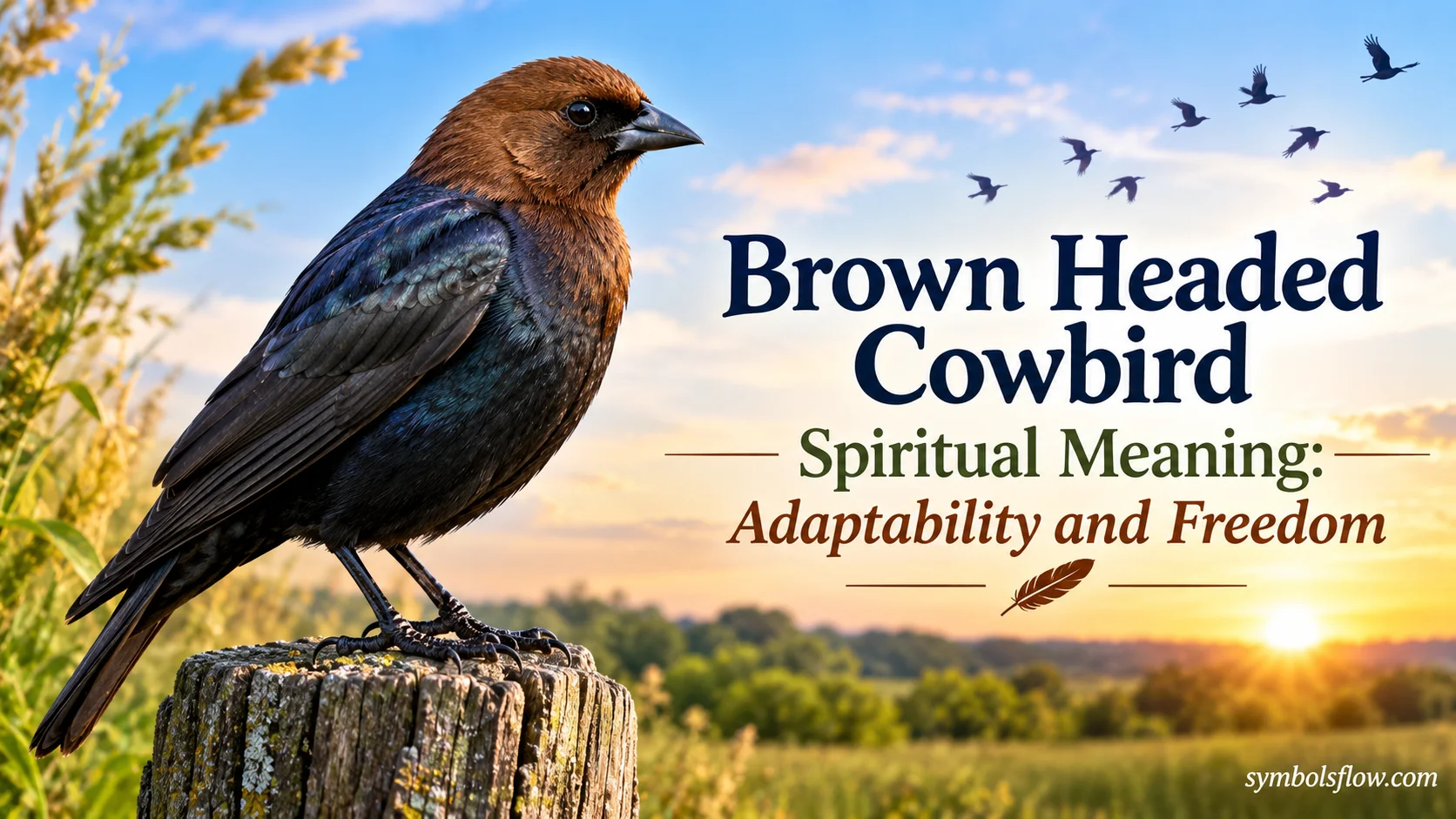
The Brown Headed Cowbird spiritual meaning is often associated with adaptability, freedom, independence, and the courage to follow your own path.
With its distinctive brown head and glossy black body, this bird reminds us that life does not always unfold according to our plans. Sometimes, unexpected changes open doors to new opportunities, personal growth, and a deeper understanding of ourselves. Seeing a brown-headed cowbird may inspire you to embrace uncertainty, trust your instincts, and remain flexible when life takes an unfamiliar turn.
Spiritually, the brown-headed cowbird can symbolize the importance of breaking away from expectations and discovering what truly matters to you. Its unusual nesting behavior, in which it lays eggs in other birds’ nests, offers a thought-provoking reminder about boundaries, responsibility, and the different ways individuals navigate life. This symbolism encourages you to consider whether you are living according to your own values or simply following the expectations of others. It can also serve as a gentle reminder to protect your personal space while respecting the needs and boundaries of those around you.
“Let’s dive in!
Quick Answer
In American spiritual interpretations, the brown-headed cowbird may symbolize adaptability, independence, unconventional paths, and questions of belonging. Its unusual nesting behavior can also prompt reflection on boundaries and responsibility, although these are personal interpretations rather than established universal beliefs.
TL;DR
- The cowbird can symbolize adaptability and finding a place in changing environments.
- Its distinctive coloring may inspire reflection on identity and standing apart.
- Its nesting behavior raises symbolic questions about belonging and responsibility.
- In the United States, it is part of familiar North American wildlife.
- Different spiritual meanings are modern interpretations, not universal ancient traditions.
- Observing the bird can encourage curiosity about nature and personal choices.
What Does the Brown-Headed Cowbird Look Like?
Understanding the cowbird’s physical appearance helps explain why people find it memorable. Its colors, shape, and behavior offer natural details that can inspire personal symbolism.
The Male and Female Cowbird
The male brown-headed cowbird has a glossy black body and a dark, chocolate-brown head. In sunlight, its feathers can look almost metallic, while its compact body and short, strong bill give it a familiar blackbird shape.
Females look different, with more muted gray-brown feathers and subtle streaking. This contrast can inspire reflections on individuality, quiet strength, and the many ways identity appears.
What Its Appearance May Symbolize
People who interpret animal encounters spiritually may connect the cowbird’s appearance with ideas such as:
- Contrast: Its brown head and black body create a striking visual difference.
- Adaptability: Its natural history reflects success in changing environments.
- Individuality: Its appearance makes it recognizable among other dark-feathered birds.
- Hidden complexity: Its ordinary look contrasts with its unusual nesting behavior.
These are possible personal associations, not fixed meanings shared by all spiritual traditions. The bird’s natural features can inspire reflection without needing to represent a definite message.
Brown-Headed Cowbird Spiritual Meaning and Adaptability
Adaptability is one of the most natural symbolic themes associated with the brown-headed cowbird. The species lives in a variety of open and partly wooded habitats, including pastures, fields, roadsides, and residential areas.
Finding a Way Through Change
Cowbirds originally relied heavily on the open grasslands of central North America. As land use changed, including the clearing of forests and the spread of livestock grazing, their range expanded.
This history can inspire a symbolic lesson about adjusting when familiar conditions change. A cowbird sighting might remind someone to reconsider an old plan, learn a new skill, or look for possibilities in an unfamiliar setting.
Adaptability Without Losing Identity
Adapting doesn’t always mean becoming like everyone else. The cowbird remains distinctive even while using habitats shared with many other birds.
In personal reflection, this can represent flexibility while maintaining core values. You may change your methods, surroundings, or goals without abandoning what matters most to you.
When This Meaning May Feel Relevant
People may find this interpretation meaningful during transitions, such as moving to a new place, changing jobs, or entering a different stage of life. The bird can serve as a reminder that adjustment is often a process rather than a single decision.
Still, seeing a cowbird doesn’t guarantee that change will be easy or successful. Its symbolism is most useful as an invitation to think about how you respond to change.
Belonging, Family, and Unconventional Paths
The cowbird’s nesting behavior is unusual among North American songbirds. Female cowbirds lay their eggs in other birds’ nests, leaving the host birds to incubate the eggs and raise the young.
A Different Way to Begin Life
This reproductive strategy is known as brood parasitism. Cowbird chicks grow up in nests built by other species, sometimes alongside chicks that look very different from them.
As a symbol, this can prompt questions about belonging and family. People may reflect on blended families, adoption, chosen family, or the experience of growing up in a community where they feel different.
These comparisons are metaphors, not direct equivalents. Human families involve relationships, care, and choices that cannot be reduced to a bird’s reproductive behavior.
Belonging Doesn’t Always Look the Same
The cowbird challenges the assumption that every animal follows the same path to adulthood. It survives through a strategy that differs from the familiar pattern of building a nest and raising its own young.
For some readers, this may symbolize the courage to follow an unconventional path. A person’s education, career, family life, or creative work doesn’t have to match everyone else’s expectations.
A Balanced Interpretation
The cowbird’s behavior also raises questions about responsibility and its effects on others. Some host species successfully raise cowbird chicks, while in other cases cowbird parasitism can reduce the survival of host birds’ young.
Therefore, the symbolism needn’t celebrate every form of unconventional behavior. It can instead encourage reflection on two questions: Does a different path suit your circumstances, and how does it affect the people around you?
Historical Background: From Grasslands to Modern America
The brown-headed cowbird has a natural history closely tied to North America’s changing landscape. Its history provides a clearer foundation for interpreting the bird than claims that assign it a universal ancient meaning.
The Bird of Bison and Cattle
Cowbirds earned their common name because they often follow grazing animals. As bison or cattle move through grass, they disturb insects that the birds can catch and eat.
This close association with large grazing mammals made the bird familiar in open grasslands. In a symbolic reading, that relationship may suggest alertness, cooperation with changing conditions, or noticing opportunities in everyday surroundings.
Expansion Across the United States
Historically, brown-headed cowbirds were strongly associated with the central grasslands. As forests were cleared and agriculture expanded, they gained access to new feeding and breeding areas.
By the late 1800s, they had spread widely into eastern parts of the United States. Their range later extended across much of North America, showing how changes made by humans can reshape wildlife patterns.
What History Can—and Cannot—Tell Us
This history supports interpretations involving adaptability and environmental change. However, it doesn’t prove that earlier Americans understood the cowbird as a spiritual sign of freedom, transformation, or family.
When exploring animal symbolism, it’s useful to separate documented natural history from modern personal interpretation. That distinction makes the meaning more thoughtful and historically grounded.
Brown-Headed Cowbird Meaning in Native North America
The brown-headed cowbird is a North American species, but that fact alone doesn’t establish one shared spiritual meaning among Indigenous peoples. Native nations have distinct histories, languages, teachings, and relationships with local wildlife.
Respecting Indigenous Traditions
Birds have important roles in many Indigenous stories and cultural practices. However, meanings vary widely, and a symbol associated with one nation shouldn’t be presented as a belief shared by all Native American communities.
There isn’t a single, universally documented Indigenous teaching that assigns the brown-headed cowbird one spiritual meaning. It’s better to avoid attributing ideas such as transformation, warnings, or ancestral messages to Native traditions without specific evidence.
Nature as a Source of Reflection
People can still learn from observing the cowbird’s place in its ecosystem. Its relationship with grasslands, grazing animals, and other nesting birds shows how species depend on one another in complex ways.
For modern readers, this may encourage respect for local wildlife and the land it inhabits. The lesson comes from observation and personal reflection rather than from claiming a cultural teaching that may not belong to one’s own tradition.
Cross-Cultural and Broader Spiritual Interpretations
Birds often appear in spiritual traditions because they move between the ground and the sky. Their flight can inspire ideas about freedom, perspective, movement, and the relationship between everyday life and the unknown.
General Bird Symbolism
Across different cultures, particular birds have been associated with messages, protection, wisdom, or change. Yet these meanings depend on the species, story, region, and religious context.
The brown-headed cowbird doesn’t have one established spiritual meaning across the world’s traditions. Modern interpretations of this particular species are often based on its unusual behavior and distinctive appearance.
A Personal Spiritual Reading
If the cowbird appears during a meaningful moment, you might treat the encounter as a prompt to consider your circumstances. Perhaps you’re navigating a transition, reconsidering your place in a group, or learning to respond to unexpected conditions.
You don’t have to conclude that the bird was sent to deliver a message. A meaningful encounter can come from paying closer attention to nature and noticing what its details bring to mind.
Avoiding Universal Claims
A spiritual interpretation becomes less reliable when it claims every culture agrees or every sighting means the same thing. Instead, keep the meaning open to personal experience and cultural context.
This approach respects traditions while leaving room for individual reflection. It also makes a clear distinction between spiritual belief and facts that can be observed in the natural world.
Read More: Right Hand Itch Spiritual Meaning: Incoming Wealth
What Does a Brown-Headed Cowbird Mean in American Culture?
In the United States, the cowbird is known more for its natural history than for a widely established spiritual tradition. Birdwatchers may recognize its appearance, while farmers and conservation workers may know it through its relationship with livestock and other birds.
A Familiar Part of the Landscape
Cowbirds can be seen in pastures, grassy fields, roadsides, parks, and some residential areas. They may gather with other blackbirds on lawns or near feeding grounds.
Because they live in human-altered landscapes, they offer a reminder that wildlife responds to changes in how people use land. This connection can inspire reflection on responsibility, coexistence, and the effects of everyday choices.
Meaning for Birdwatchers and Nature Lovers
For people who enjoy birdwatching, spotting a cowbird may simply be an opportunity to identify a local species. Others may use the encounter as a personal symbol of flexibility or independence.
The same sighting can have different meanings without either interpretation needing to be universal. American wildlife culture includes both scientific observation and personal enjoyment of nature.
Common Interpretations Today
| Context | Possible symbolic meaning | Natural background |
| Seeing one in a field | Adaptability and awareness | Cowbirds forage in open habitats |
| Noticing its contrasting colors | Individuality and distinction | Males have brown heads and glossy black bodies |
| Watching it among other birds | Belonging and difference | Cowbirds use shared feeding areas |
| Learning about its nesting behavior | Unconventional paths and responsibility | Females lay eggs in other birds’ nests |
| Seeing it near grazing animals | Opportunity and changing conditions | Livestock can stir up insects for feeding |
These are reflective interpretations rather than official American beliefs. They offer ways to connect the bird’s natural history with everyday questions.
Emotional and Psychological Associations
Animal encounters can feel meaningful because they connect an outside observation with something happening in a person’s life. The cowbird’s unusual traits may be especially striking when someone is thinking about independence, family, or change.
Independence and Self-Trust
The cowbird’s reproductive strategy differs from the familiar nesting behavior of many songbirds. This can inspire thoughts about choosing a path that doesn’t match social expectations.
For someone facing pressure to follow a certain career or lifestyle, the bird may become a reminder to think independently. However, independence also involves considering consequences and respecting other people’s needs.
Identity and Feeling Different
The male’s brown head and black body create a clear contrast. Symbolically, that visual difference can suggest the experience of standing out while still being part of a larger group.
This may resonate with people entering a new community or discovering a part of themselves they previously kept private. The bird doesn’t tell them what choice to make; it simply offers an image for reflection.
Boundaries and Responsibility
The cowbird’s nesting strategy can also raise uncomfortable questions about how individual needs affect others. In human relationships, the comparison might encourage someone to consider whether they give and receive support fairly.
This is not a judgment of people whose family lives look different from traditional expectations. Rather, it is a reminder that belonging, support, and responsibility can take many forms.
Brown-Headed Cowbird in Dreams and Repeated Sightings
Some people look for spiritual meaning when a particular bird appears repeatedly or enters a dream. A brown-headed cowbird may feel especially significant because of its distinctive appearance and unusual place in the bird world.
Seeing a Cowbird in Everyday Life
If you notice a cowbird several times, the repetition may encourage you to pay closer attention to your surroundings. You might associate the encounters with a current transition or a question about where you belong.
However, repeated sightings can also have simple explanations. Cowbirds are common across much of North America, and they often gather in places where food is available.
Dream Interpretations
There is no universal dream tradition that assigns the brown-headed cowbird one fixed meaning. Still, someone exploring personal symbolism might connect the bird with adapting to change, feeling different, or reconsidering family expectations.
The dream’s emotional tone may matter more to the dreamer than the bird alone. A calm encounter might suggest curiosity, while a troubling scene could reflect a current worry or unresolved question.
Questions for Personal Reflection
If a cowbird encounter stays in your mind, consider asking yourself:
- What was happening in my life when I noticed the bird?
- Did its behavior remind me of a relationship or situation?
- Am I adjusting to a change I didn’t expect?
- Do I feel comfortable with my current place in a group?
These questions can help you explore your own associations without assuming the bird predicts an event. You can also enjoy the encounter simply as a moment of connection with nature.
Modern Uses in Art, Tattoos, and Social Media
The brown-headed cowbird isn’t as widely recognized as some symbolic birds, such as eagles, owls, or cardinals. Nevertheless, its distinctive coloring and unusual behavior can inspire creative work and personal storytelling.
Tattoos and Artwork
Someone who chooses a cowbird tattoo may be drawn to its appearance or its place in the natural world. Others might connect it with adaptability, individuality, or a personal experience of belonging.
Possible design elements include:
- A male cowbird on a branch, emphasizing its contrasting colors.
- A cowbird in an open meadow, suggesting connection with nature.
- A pair of birds, exploring difference and coexistence.
- A small, realistic bird portrait, celebrating wildlife observation.
These designs don’t carry one official symbolic meaning. Their significance depends on the person’s intention and the story behind the artwork.
Social Media and Personal Meaning
Online posts often give animals short spiritual descriptions, making their meanings easy to share. A cowbird might be described as a sign of change, independence, or unconventional growth.
However, a modern post may be a creator’s personal interpretation rather than a long-standing tradition. If a claim says the bird always brings a warning or guarantees a new beginning, it’s worth treating that statement cautiously.
Home Decor and Nature-Inspired Identity
A bird illustration, nature photograph, or field-guide print can express a person’s love of wildlife. For some, it may also represent patience, curiosity, or respect for the environment.
Unlike a fixed religious emblem, a cowbird image can remain personal and flexible. It may be meaningful because of a memory, a place, or an interest in birdwatching rather than a spiritual belief.
Misunderstandings and Controversies About Cowbird Symbolism
The brown-headed cowbird’s unusual nesting behavior can lead to strong reactions. Some people see it as a lesson in survival, while others focus on the harm it can cause to other birds.
Is the Cowbird a Bad Omen?
There is no reliable basis for treating a cowbird sighting as a warning of misfortune. Its reputation depends on the interpretation a person brings to the encounter.
The bird’s behavior may be challenging to understand, but that doesn’t make it a supernatural threat. In nature, its actions reflect an evolved reproductive strategy rather than a moral choice.
Is Its Nesting Behavior Wrong?
Cowbirds lay eggs in other birds’ nests, and host parents may raise the chicks. In some cases, the cowbird chick’s needs can reduce the survival of the host species’ young.
From a conservation perspective, this behavior can be a serious concern for certain vulnerable bird populations. However, describing the behavior as morally bad applies human judgments to an animal following its natural biology.
Conservation and Human Responsibility
Cowbirds benefited from changes such as forest clearing and the expansion of grazing areas. In some locations, their nesting behavior has contributed to pressure on vulnerable songbirds.
Wildlife managers have sometimes used targeted cowbird control to protect endangered species. Such measures can be controversial, so conservation decisions are best understood through local evidence, species needs, and habitat conditions.
For personal symbolism, this history offers a balanced lesson: adaptability can help one species succeed while creating challenges for another. It encourages awareness of the wider effects of change rather than a simple judgment of good or bad.
How the Cowbird’s Meaning Can Change Over Time
Animal symbolism is not fixed forever. Meanings can shift as people learn more about a species, encounter it in new settings, or reinterpret its behavior through modern ideas.
From Practical Observation to Personal Symbol
Historically, the cowbird’s relationship with grazing animals helped explain its common name. Its behavior was part of the everyday experience of people living or working in open landscapes.
Today, someone encountering the bird may also think about adaptability, family structures, or identity. These newer associations build on the bird’s natural history but don’t necessarily represent older cultural beliefs.
From Folklore to Online Interpretation
Digital content makes it easy for an individual interpretation to reach a wide audience. A symbolic meaning can spread quickly even when it began as a personal reflection rather than a documented tradition.
That doesn’t mean modern interpretations have no value. It simply helps to label them accurately, distinguishing creative spiritual readings from historical evidence.
Keeping Meaning Open and Grounded
A thoughtful interpretation leaves room for more than one perspective. You can appreciate the cowbird’s survival strategy while recognizing its effects on other birds.
You can also find personal inspiration in its appearance without claiming that every sighting carries a message. The most useful meaning is one that encourages curiosity, care, and a better understanding of the natural world.
FAQs
Is seeing a brown-headed cowbird a good sign?
Some people may take the sighting as a reminder to stay flexible or trust their own path. However, there is no established rule that the bird brings good luck or predicts a specific event.
What does a brown-headed cowbird symbolize in Native American culture?
There is no single meaning that represents all Native American nations or traditions. Specific claims should be tied to a reliable source and the particular community involved, rather than applied broadly to Indigenous cultures.
Why is the brown-headed cowbird associated with unconventional family roles?
Female cowbirds lay their eggs in other birds’ nests, where the host birds may raise the chicks. This behavior can inspire metaphors about belonging and different family structures, but human relationships are far more complex than bird behavior.
What does a brown-headed cowbird mean in a dream?
A personal interpretation might connect the bird with change, identity, or questions about belonging. Dream symbolism is subjective, so consider the feelings and circumstances surrounding the dream instead of assuming one fixed meaning.
Is the brown-headed cowbird considered negative because of its nesting behavior?
Its brood-parasitic behavior can harm the reproductive success of some host birds, making it a conservation concern in certain settings. Still, the behavior is part of its natural biology and doesn’t make the bird a spiritual symbol of evil or misfortune.
Conclusion
The Brown Headed Cowbird Spiritual Meaning can be explored through adaptability, individuality, belonging, and the effects our choices have on others. Its brown head, glossy black body, and unusual nesting strategy make it a distinctive bird with plenty of natural details to consider.
In the United States, the cowbird’s documented story is closely connected to grasslands, grazing animals, and changing landscapes. Spiritual interpretations add a personal layer to that history, but they shouldn’t be confused with proven predictions or universal ancient teachings.

1 thought on “Brown Headed Cowbird Spiritual Meaning: Adaptability and Freedom”